Wednesday, June 6, 2012

Pressuring E.U. States: The Debt Crisis as Leverage

By mid 2012, the verdict was in on the German-led recipe for restoring states overwhelmed by public- or private-sector debt: Austerity is counter-productive in reducing government deficits. On June 6, 2012, the media reported: “Prolonged austerity is making it harder, not easier, for governments like Greece to become self-reliant again.”[1] Salaries and pensions in the private and the public sectors in the state had been cut by up to 50 percent, leaving Greece 495 million euros short of its revenue targets in the four months ending the previous April, according to the Greek Finance Ministry.[2] With less cash, consumers had to reduce spending, leading thousands of taxpaying businesses to fail. Income expected from a higher, 23 percent value-added tax required by the bailout agreement fell short by around 800 million euros in the first four months of 2012. That is partly because cash-short businesses that were once law-abiding started hiding money to stay afloat, tax officials said.


The complete essay is at Essays on Two Federal Empires.


1. Liz Alderman, “Greece Warns of Going Broke as Tax Proceeds Dry Up,” The New York Times, June 6, 2012.
2. Ibid.

Sunday, June 3, 2012

The Wisconsin Recall Election: A Predictor of the U.S. Presidential Election?

According to Paul Abowd of the Center for Public Integrity in 2012, the election to fill the governor’s office in the wake of Scott Walker’s recall “has become a referendum on the future of public sector unions.”[1] That the union of teaching-assistant students at the University of Wisconsin in Madison refused to endorse Barrett precisely because he was not making collective bargaining rights a salient part of his campaign would suggest that Abowd had it wrong. Moreover, it is a mistake to read the election results in Wisconsin as a harbinger of things to come in the U.S. presidential election five months later in November 2012.

During his campaign, Barrett downplayed the public-sector union issue because he figured he already had his base, which had detested Walker for more than a year. Barrett was going for the independents who saw the recall petition as sour-grapes by a vocal interest group (the student union validating this judgment). Most tellingly, the teaching-assistant student-union had even refused to endorse the unions’ own favorite for Democratic nominee, Kathleen Falk, who had lost to Barrett in the primary by twenty points. Falk had promised not to sign any legislation until a bill restoring the public-sector unions' collective-bargaining rights is presented. You cannot get much more pro-union than that, and yet even THAT was not good enough for the graduate students at the University of Wisconsin in Madison. At the very least, it would appear that the graduate school's admissions committees at the university in Madison could have been doing better in their decisions, at least in regard to assessing maturity and judgment. 

I count it as a good thing that Barrett’s position on restoring the Wisconsin government workers’ bargaining right was less “my way or the highway” than was Falk’s position because Barrett was evincing a more mature or seasoned approach to governance. In contrast, the teaching-assistants’ union can be read as evincing the self-defeating and immature rigidity of “my way or the highway.” The contending camps in Wisconsin’s Democratic Party reflected this difference of political culture between Milwaukee and Madison. Hence, the dynamic cannot be assumed to operate at the U.S. level.

Furthermore, Mitchell, a young fireman whose involvement in his union probably won him the Democratic nomination for Vice (or lieutenant) Governor (as an after-thought by most voters), was at the time both too young and inexperienced in terms of public office to occupy the second-highest office in the land, not to mention the highest. At an outdoor rally in a street-alcove after a motley march that took place in downtown Madison the day after the primary, Mitchell easily stood out in video of the event because he was the only person in the warm weather wearing a grey suit. His political inexperience really stood out as he could be seen walking through the crowd, insisting on shaking hands with people even as they were trying to listen to the speakers. Perhaps most tellingly, he bumped into at least one person who preferred to keep listening to the speaker rather than turn around to shake hands. I suspect that Mitchell was trying to be a "professional" politician in a very atypical (and thus inappropriate) context (i.e., the recall). This itself essentially disqualified him from the office he was seeking, especially because it was possible that had he won along with Walker, the young fireman could have found himself assuming the office of governor.

The quality of the Democrats’ choice for vice governor mattered particularly because Walker was being investigated at the time by U.S. and Wisconsin law-enforcement agencies for corruption while he had been chief executive of the County of Milwaukee. In Illinois, Quinn had become the head of state and chief executive of the government when "Blago" was impeached and removed from office for trying to sell Barak Obama's vacated U.S. Senate seat. Were Mitchell to have won even as Bartlett lost, the novice could have found himself eventually taking over for Walker. It is not at all advisable to have a political novice in the highest office in the land. I suspect that this factor weighed on independent voters.

It would be perfectly understandable, therefore, for Wisconsinites in favor of Barrett to have skipped the lieutenant governor race based on principle (i.e., putting the interest of the public good over partisanship), even if that could have resulted in the governor and lieutenant governor being of different parties. Because the lieutenant governor office has some important powers when the governor is not in Wisconsin, such a scenario would certainly not be optimal for Barrett supporters. Therefore, I believe the Democrats in Wisconsin dropped the ball in voting in the primary for a nominee for lieutenant governor. To be sure, they made a good choice in picking Barrett’s mature approach to restoring union rights over Falk’s “my way of the highway” mentality on the "single issue" of a union's bargaining rights. The refusal of at least one union in Madison to back Barrett further compromised the Democrats’ strength in defeating Walker.  These are idiosyncratic elements in the Wisconsin “recall election” that don’t project onto the U.S. as a whole. 

Most obviously, going into the recall election, the sitting governor of Wisconsin was a Republican whereas the sitting U.S. president was a Democrat. Also, whereas Mitchell was a political novice at the time (being plucked out of a fire department union), Obama’s VP was an experienced former U.S. Senator and VP. In terms of the parties, Barrett was not associated with Obama's weaknesses (e.g., Obamacare), and Walker did not have Romney's problems with conservatives. Indeed, some Obama supporters crossed over to vote for Walker--a fact that Obama no doubt had foreseen as he was staying away from campaigning for Barrett.

Moreover, the United States is not a state with a very large back yard. Given the heterogeneous political, economic, religious and social cultures of the republics in the U.S., it is not a good idea to simply project the results in Wisconsin on the U.S. as a whole. Furthermore, there are issues that are only relevant at the U.S. level, such as foreign policy. I must conclude that the U.S.-based media was being much too simplistic in regarding the Wisconsin race as an indicator of the “upcoming” U.S. elections. Lest all politics is local, the results of a U.S.-wide election can be viewed as a quilt of various majorities rather than as one huge aggregate. Yet reductionism to U.S.-level politics seems a preoccupation or obsession, at least for the major American media companies, as if the American republics existed only in so far as they contribute to U.S. races. I suspect that the culprit is American business more generally, as large corporations have found it cheaper to have one set rather than fifty sets of government regulations. Reducing American politics to the U.S. stage serves this purpose.


1. Amanda Terkel, “Wisconsin Recall: Election Law Quirk Could Throw Governance Into Disarray,” The Huffington Post, June 3, 2012. See Paul Abowd, “CPI: Wisconsin Recall Battle Is State’s Most Expensive Election,”MSNBC.com, June 3, 2012. 

Friday, June 1, 2012

European Central Bank to E.U. Leaders: Vision Is Needed

Mario Draghi, president of the European Central Bank, warned a committee of the E.U.'s parliament at the end of May 2012 that the structure undergirding the euro in the E.U. had become "unsustainable." He criticized political officials for having kicked the can down the road by enacting half-measures or else delaying decisions, thus making the debt crisis even worse than it otherwise would have been. "The next step is for our leaders to clarify what is the vision for a certain number of years from now."[1] Similarly, Olli Rehm, vice president of the E.U. Commission (the E.U.'s executive branch), said that ways must be found to avoid a disintegration of the common currency.


The full essay is in Essays on the E.U. Political Economy, available in print and as an ebook at Amazon.


1. Jack Ewing, "A Terse Warming for Euro States: Do Something New," The New York Times, May 31, 2012.

Wednesday, May 30, 2012

No State Left Behind: American Education Eclipsing Federalism

Facing a federal requirement that every student be proficient in math and English by 2014, the member-states in the U.S. rushed to apply for waivers in 2011 and 2012. In 2010, 38 percent of the schools had failed to meet their goals for annual progress toward the 2014 goal. The U.S. Secretary of Education thought that figure could soar to 80 percent. When a school fails to meet such goals, the No Child Left Behind law requires “a series of interventions by the district and the state that can culminate in a state takeover. With so many schools failing, “that threatened to create an impossible burden on states and districts,” according to Chester Finn, director of an institute that studies education.[1] The waivers did not come without strings, however. The Obama administration pushed the governments to measure teacher performance, and put increased emphasis on low-performing groups as well as on the lowest-performing schools.

While the waivers can easily be seen as an effort to put the Obama administration’s own priorities on legislation from a prior administration, the Secretary of Education, Arne Duncan, claimed that his aim was to get out of a bad law that could overwhelm states that don’t measure up. “Our goal with this waiver process, frankly, has always been to get out of the way of states and districts,” he said.[2] If this were so, however, he would not insist on negotiating for better terms in granting the waivers. Beyond this extent of intervention, that of the No Child Left Behind law requiring “interventions by the district and the state” with failing schools interlards the U.S. Government in a domain that is constitutionally reserved to the states. Absent the enumerated (i.e., listed) powers of the federal government, the fifty republics are sovereign states. While the Congress can spend in the general welfare of the political and monetary union, strings beyond the general purpose trigger a breach of the constitutional design, which should give the republics enough power to act as a check on the other system of government—that of the union itself. That is, specifying down to district intervention meddles inordinately in a state’s system of government to implement federal law.

In terms of education, the role of the U.S. Government should be oriented to regulating the interstate aspects, such as making sure that students are not deprived of equal protection (e.g., not discriminated against) and that out-of-state students are not gauged at the university level. Any spending should come attached to a general purpose (which I believe must be within an enumerated power, especially if there are any strings attached), rather than with requirements for implementation (or penalty). Should a republic not spend the money in line with the purpose (especially if that purpose lies within one of the sovereign domains of the member states), the federal government could sue to get the money back. If this seems to restrict Congressional power unduly, it may be that the federal power had gone so far beyond what is consistent with a federal system that what seems drastic is merely what is necessary to get back in line with it. In terms of failing schools, the underlying problem may be that Americans (i.e., including parents of school children) do not value self-discipline (i.e., at the expense of instant gratification) or education itself enough. Imposing federal requirements and penalties are doomed to fail against such societal disvalues. In other words, we are trashing federalism for nothing.


1. Richard Perez-Pena, “Waivers for 8 More States from ‘No Child Left Behind,” The New York Times, May 30, 2012.
2. Ibid.

Thursday, May 24, 2012

Eurobonds for Stimulus Spending

Meeting on May 23, 2012, the E.U.’s European Council failed to come up with a plan to offset the recessionary aspect of Greece’s budget cuts. The pressure was on; the OECD had just warned that the E.U. go back into recession. Interest rates on state debt-namely that of Spain—had reached an unsustainable level the week before due to concern regarding banks based in the state. Besides the debt and banking vulnerabilities at the state level, the E.U. itself was struggling with its political weakness, which can be attributed to the states’ rights (or euro-skeptic) ideology that was not exactly going away in the context of the debt-contagion that had prompted the establishment of a permanent E.U. bailout fund for states in over their heads on debt. In this context, the European Council was at the intersection of debt, banking and political problems.


The full essay is at Essays on the E.U. Political Economy, available in print and as an ebook at Amazon.

Monday, May 21, 2012

Facebook’s IPO: Morgan Stanley’s Conflict of Interest

Morgan Stanley’s underwriting of Facebook’s IPO has been thought by some of the bank’s rivals to be incompetently managed.  According to the New York Times, “(r)ival bankers and big investors have complained that Morgan Stanley botched the I.P.O., setting the price too high and selling too many shares to the public.”[1] Interestingly, the incompetence is positively correlated with unethical policy decisions at the bank. Even as the bankers as underwriters were eager to sell lots of shares, they may have given some of their institutional customers—albeit only the most preferred, as per the bank’s other services—some privileged information. If this charge is true, the conflict of interest at the bank should be closely examined by Congress and any relevant regulators.


The full essay is at Institutional Conflicts of Interest, available in print and as an ebook at Amazon.


1. Evelyn Rusli and Michael De La Merced, “Facebook I.P.O. Raises Regulatory Concerns,” The New York Times, May 22, 2012.

Wealth and Happiness American-Style

The Organization for Economic Cooperation and Development released an up-dated version of its Better Life Index in May 2012. The U.S. ranked first in income, with average household wealth at $102,000, as well as in housing (Americans spending about 20% of their disposable income on it—the OECD average being 22%).[1] These figures for the U.S. could have been pushed upward by the fact that at the time, the very rich were richer than their counterparts in other countries, for the gap between rich and poor was relatively high in the U.S. For example, 30 million Americans were without health insurance and a record number of Americans were receiving a governmental subsidy for food. Rather than assume that the middle and lower economic segments in the U.S. were better off than their counterparts in other regions of the world, I suspect that the statistics reflect the higher relative pay of American executives and professionals (lawyers, physicians and CPAs). The typical CEO in the E.U., for example, made less than his or her counterpart in the U.S.  This caused trouble in the Chrysler-Daimler merger because the Chrysler executives enjoyed higher compensation even though Daimler was in charge.

Interestingly, the rank of the U.S. in life satisfaction was above average, with 76 percent of people reporting having more positive than negative experiences in an average day (the average in the OECD index being 72%). In other words, the gap between the rich and poor does not appear to have gotten in the way of life-satisfaction. Although economic reductionism is particularly salient in the U.S., such satisfaction does not reduce to dollars and cents. Even in economic terms, the large gap between the rich and poor includes geographic distance. For example, court-orders have had to be used to force some cities and towns to allow subsidized (low-income) housing. Meanwhile, it is not uncommon, particularly in Florida, for people with money to live in gated communities. With the rich out of sight, the poor are less likely to be aware of the economic inequality, which could otherwise put a damper on their life-satisfaction.

As a final observation, my reference to Florida suggests that the OECD should not generalize all of the American states into one figure. For example, life-satisfaction is likely to be higher in Hawaii than in Alabama or Michigan for climatic or economic reasons (or in North Dakota during the winter even considering the economic boom). Housing in New Hampshire is, in general, better than in Mississippi. Income in Connecticut is higher on average than in Arkansas. For states, whether in the U.S. or E.U., to be in a union is not to say that they are identical and thus readily grouped together. In other words, a general statistic in housing or income has less real meaning when applied over such a large area. It is like saying that the average temperature in the U.S. in 2011 was 56 degrees (I don’t know the real figure). It is unlikely that figure applies in any state—certainly not in Florida, Hawaii, Alaska, or Maine. The figure has no real meaning, other than relative to other such figures over time (e.g., to assess global warming). For the OECD to compare the U.S. as a whole to E.U. states such as Denmark, Belgium and Spain suggests that the organization is content to engage in category mistakes. If the figures are relevant on the state level, the OECD should be consistent rather than selectively over-generalize.


Sunday, May 20, 2012

"Real Change" Belied: Lobbyists in Obama's White House

Visitor logs for January 17, 2012 show that the lobbying industry that Obama had vowed to constrain was nonetheless a regular presence at 1600 Pennsylvania Ave.[1] That's the address of the White House. Even though the president barred recent lobbyists from joining his administration or even serving on its advisory boards and forbid federal employees from accepting free admission to receptions and conferences sponsored by lobbying groups, records suggest that lobbyists with personal connections to the White House enjoyed the easiest access. The principle of fairness (not to mention consistency) seems to have been sacrificed for political (and campaign finance) expediency.

Lobbyist Marshal Matz, for example, who served as an unpaid adviser to Obama’s 2008 campaign, gained access to the White House roughly two dozen times through May 2012.[2] He brought along the general council for the Biotechnology Industry Organization, the chief executive of cereal maker General Mills and pro bono clients, including advocates for farmers in Africa. It seems that the “Wall Street needs reform” president was rather pro-business behind the gates.

Another such lobbyist with close ties to the White House was former New York congressman Tom Downey, who at the time was married to Carol Browner. Until 2010, she was Obama’s energy czar. Downey was the head of Downey McGrath Group, a lobbying firm whose clients include Time Warner Cable and Herbalife, which sells nutrition and dieting products. As of January 2012, he had been to the White House complex for meetings and events 31 times. On Dec. 10, 2010, Downey held a meeting with economic adviser Lawrence H. Summers and just happened to bring along Bill Cheney, the head of the Credit Union National Association and one of Downey McGrath’s clients. John Magill, the top lobbyist for the association, said that the group was pushing to lift the cap on the percentage of assets its members can lend out.[3]

“A lot of folks,” Obama said in April 2012, “see the amounts of money that are being spent and the special interests that dominate and the lobbyists that always have access, and they say to themselves, maybe I don’t count.”[3] That is also the inevitable reaction from the White House visitor log. Even members of Congress may conclude that they don't count.

According to U.S. Sen. Ron Wyden (D-Oregon), for example, the U.S. Trade Representative was sharing draft negotiation documents on the Trans-Pacific trade deal with the governments of other countries and American corporate executives who serve on advisory boards, no such access was being provided to the majority of Congress or most nonprofit groups. "The majority of Congress is being kept in the dark as to the substance of the TPP negotiations, while representatives of U.S. corporations--like Halliburton, Chevron, PhRMA, Comcast and the Motion Picture Association of America--are being consulted and made privy to details of the agreement," Wyden said[4]. A subsidiarity of Halliburton had been accused by the U.S. military of charging it $1.6 billion for fake services. The Motion Picture Association had former U.S. Senator Chris Dodd (D-Conn.) as its head. 

Furthermore, ABC News had reported in 2011 that employees of Comcast had "contributed more money to President Obama's reelection bid than employees from any other organization, according to [an] analysis of the Federal Election Commission data by the Center for Responsive Politics."[5]  It appears that the Obama administration was being quite responsive to Comcast in enabling the company to "buy" the access to the trade negotiations. In fact, Obama attended "an intimate fundraiser at the home of Comcast executive vice president David Cohen in Philadelphia in June [2011] and a private 'social reception' at the Martha's Vineyard estate of Comcast CEO Brian Roberts [in August 2011]. Cohen put together more than $500,000 in contributions to the Obama campaign and the DNC for the 2012 election. Nonetheless, the president’s press secretary—speaking as if tone-deaf—said, “Our goal has been to reduce the influence of special interests in Washington — which we’ve done more than any Administration in history.”[6] 

It seems to me that the Obama administration's mutual back-scratching with big business can explain why Obama caved on the "public option" in his health-insurance reform law--essentially handing the existing private insurance companies tens of millions of new customers financed by the U.S. Government without any competition from a public insurer. The close ties can also explain why Obama backed off from his statements that Wall Street banks too big to fail should be broken up preemptively (rather than merely having the government get involved to help out on the liquidation after a bank has gone bankrupt as is the case in the resulting law). Even though the positive correlation of campaign contributions and favorable access and legislation (and trade negotiations) does not in itself prove the existence of a quid pro quo, the fingerprints are all over the darkened windows of Obama's White House. Rather than attacking capitalism, Obama was wallowing in it even as he occasionally threw red meat to his anti-corporate base to get it out to the polls. 

Moreover, both the matter of White House access and access to trade deal negotiation point to the partisan nature of the office of the U.S. Presidency. With regard to the White House access, the Post reports that “Republican lobbyists coming to visit are rare, while Democratic lobbyists are common, whether they are representing corporate clients or liberal causes.” This suggests that the presidency itself may be more partisan than is consistent with representing the United States itself (i.e., the figure-head role of the office).

In general terms, it would be naïve to suppose that powerful figures in Washington, D.C. could somehow be immune from lobbyists when the clients have so much money (i.e., economic power). In other words, concentrated wealth must needs eventuate in pressure on public policy. To restrict lobbyist access at the White House would thus only plug a hole that is a symptom. While doing so might assuage our frustration at such blatant favoritism bought with campaign (or SuperPac) donations, it is that money and the related mammoth size and power of modern corporations that must ultimately be challenged for there to be any change in substance. However, we should not be so naïve as to expect that barring lobbyists from the People’s House or even outlawing corporate political campaign contributions would reduce the influence. Where there are deep pockets of concentrated private wealth, the public weale must needs be so oriented. 


1. T. W. Farnam, “White House Visitor Logs Provide Window into Lobbying Industry, The Washington Post, May 21, 2012.
2. Ibid.
3. Ibid.
5. Devin Dwyer, "Comcast Employees Top Donors to Obama Campaign Accounts," ABC News, August 25, 2011.
6. Ibid.

Saturday, May 19, 2012

Unions and States at a G-8 Meeting

At the G-8 summit at Camp David in May 2012, E.U. and U.S. leaders met with the leaders of four E.U. states (Italy, Germany, France and Britain). As this picture illustrates, the qualitative differences between looking after a union of states and a state can show up unintentionally in informal seating arrangements. In the context of the European debt crisis—in particular, whether to give one state (i.e., Greece) stimulus cash or just insist on the austerity programs already agreed to—the governors of the E.U. states have particular agendas (given the financial interests of the respective states) whereas the federal officials are oriented to the good of the whole (i.e., the E.U.). President Obama of the U.S. was by the time of the summit used to taking such a perspective over and above the interests of particular U.S. states. Such a commonality of federal, empire-level interests as distinct from the relatively particularized interests of E.U. (and U.S.) states could be reflected in the seating arrangement in the picture taken by the White House, wherein Obama, Barroso (sitting next to Obama), and Van Rompuy (in the sweater) seem to be facing the four governors. The seating arrangement could just as easily have been a circle. It probably was, originally, and I suspect that the federal v. states distinction operated unconsciously on the participants such that the three federal officials came to be as though a line facing the four governors of E.U. states.


The complete essay is at Essays on Two Federal Empires, available at Amazon.

Friday, May 18, 2012

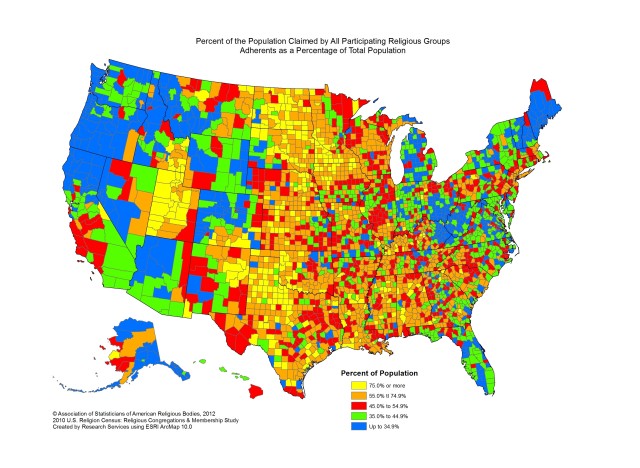
The United States as Religious and Secular Societies

E pluribus unum, or “Out of many, one,” is a motto for the United States—the American States that are united. The many can refer, I suppose, to the sheer number of inhabitants stretching across a continent and beyond. The word could also refer to the diversity of people living even in a large American city. Finally, the word could refer to the Union consists of many different socio-political societies, or republics—again possibly referring to the number of states or the fact that they differ so from one another.  It is the last interpretation that I want to explore here, for it alone gets at the fact that the U.S., like the E.U. and China, are at the empire-level (or scale) in twentieth-century (rather than medieval) terms (i.e., scaling).

Yellow: most "religious."  Blue: least "religious" (as per regular attendance). Notice the "river" of yellow running through the (political) "red states" in the middle of the map. Even so, "yellow" is doubtless not homogenous.


The complete essay is at Essays on Two Federal Empires, available at Amazon.