
Saturday, May 19, 2012

Unions and States at a G-8 Meeting

At the G-8 summit at Camp David in May 2012, E.U. and U.S. leaders met with the leaders of four E.U. states (Italy, Germany, France and Britain). As this picture illustrates, the qualitative differences between looking after a union of states and a state can show up unintentionally in informal seating arrangements. In the context of the European debt crisis—in particular, whether to give one state (i.e., Greece) stimulus cash or just insist on the austerity programs already agreed to—the governors of the E.U. states have particular agendas (given the financial interests of the respective states) whereas the federal officials are oriented to the good of the whole (i.e., the E.U.). President Obama of the U.S. was by the time of the summit used to taking such a perspective over and above the interests of particular U.S. states. Such a commonality of federal, empire-level interests as distinct from the relatively particularized interests of E.U. (and U.S.) states could be reflected in the seating arrangement in the picture taken by the White House, wherein Obama, Barroso (sitting next to Obama), and Van Rompuy (in the sweater) seem to be facing the four governors. The seating arrangement could just as easily have been a circle. It probably was, originally, and I suspect that the federal v. states distinction operated unconsciously on the participants such that the three federal officials came to be as though a line facing the four governors of E.U. states.


The complete essay is at Essays on Two Federal Empiresavailable at Amazon.

Friday, May 18, 2012

The United States as Religious and Secular Societies

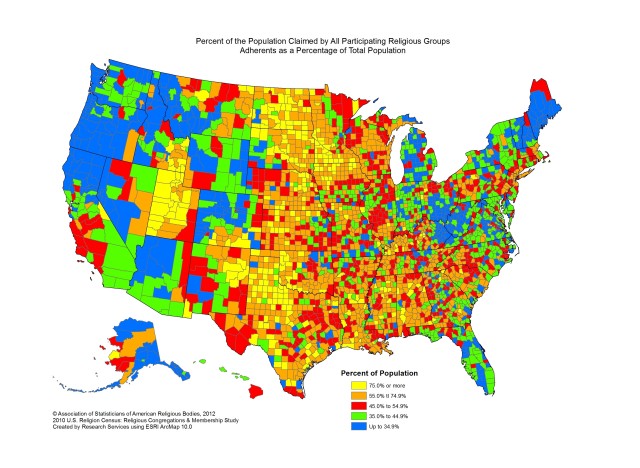
E pluribus unum, or “Out of many, one,” is a motto for the United States—the American States that are united. The many can refer, I suppose, to the sheer number of inhabitants stretching across a continent and beyond. The word could also refer to the diversity of people living even in a large American city. Finally, the word could refer to the Union consists of many different socio-political societies, or republics—again possibly referring to the number of states or the fact that they differ so from one another.  It is the last interpretation that I want to explore here, for it alone gets at the fact that the U.S., like the E.U. and China, are at the empire-level (or scale) in twentieth-century (rather than medieval) terms (i.e., scaling).

Yellow: most "religious."  Blue: least "religious" (as per regular attendance). Notice the "river" of yellow running through the (political) "red states" in the middle of the map. Even so, "yellow" is doubtless not homogenous.


The complete essay is at Essays on Two Federal Empires, available at Amazon.

Tuesday, May 15, 2012

A Conflict-of-Interest in Lobbying: The Case of JPMorgan

At the JP Morgan stockholder meeting on May 15, 2012, as the FBI was opening an investigation into the bank’s $2 (or $3 )billion loss on credit derivatives, Chair/CEO Jamie Dimon gave what the Huffington Post calls “a spirited defense of the bank’s efforts to lobby against stiffer financial regulation.” He argued that the bank’s interest is the same as the stockholders—namely, to make the financial system strong and sound. What he omitted was the part about the bank’s interest including its own profit, even if systemic risk of the system is increased as a result. In general, any business looks primary after its own interests, and only then to the general interests of the system.


The full essay is at "JPMorgan: An Unethical Monstrosity," available at Amazon. 

Monday, May 14, 2012

California Fiscal Policy: The Crowding-Out Effect

In the U.S. Constitutional Convention of 1787, some delegates expressed the concern that giving the General (federal) Government the authority to tax income would eventually result in a “crowding out” of the ability of state governments to raise revenue. Over two hundred years later, in 2012, California had cut its budget by 20 percent over the previous three years and was still faced with a $16 billion deficit.[1] Unlike Greece, California cannot avail itself of bailout funds from the federal level. Additionally, the Federal Reserve, like the European Central Bank, is barred by statute from bailing out a state government. Even as the U.S. Government places certain requirements on California’s budget that make it more difficult for the Government of California to make cuts, it could not avail itself of the bailout (TARP) that had benefitted Wall Street banks and the Michigan auto industry.


The complete essay is at Essays on Two Federal Empires, available at Amazon.

Sunday, May 13, 2012

Tsipras against Austerity: Merkel Bends on Stimulus

Under pressure to join a unity government in Greece with the New Democracy and Socialist parties, Tsipras of a “radical left” Syriza party was holding firm as of May 13, 2012. Even as the resulting prospect of new elections and a possible reneging on the agreement by Greece, there is something to admire in Tsipras’ position.

Greek president Karolos Papoulias meeting with leaders of the three main parties (Tsipras on right) AP


The full essay is in Essays on the E.U. Political Economy, available in print and as an ebook at Amazon.