Showing posts with label confederations. Show all posts

Thursday, February 19, 2026

The European Commission: An Aggregate of the States?

The European Union’s governmental institutions are not limited to the European Council and the Council of Ministers, both of which represent the state governments directly at the federal level. Nor, moreover, is the E.U. an aggregation of its states. In foreign affairs, for example, the E.U.’s foreign minister, Kaja Kallas, can speak and take decisions on the basis of consensus rather than the unanimous consent of state-level officials being required. Therefore, the Von der Leyen administration did not overreach in taking the “decision to send the Commissioner for the Mediterranean, Dubravka Suica, as an observer to the first former gathering of the United States President Donald Trump’s Board of Peace” on 19 February, 2026.[1] That Suica was merely an observer suggests that the objecting state officials were overreacting as well as misconstruing the E.U. as a confederation of sovereign states.

The Board of Peace originated at the very least in part to guide the real-estate redevelopment in Gaza. Accordingly, a spokesperson at the Commission explained the E.U.’s interest as follows: “Our participation is really to be seen in the context of our long-standing commitment to the implementation of the ceasefire in Gaza, as well as our commitment to take part in international efforts when it comes to the recovery and reconstruction of Gaza. We do believe that we need to be at the table, otherwise we will simply be a payer and not a player.”[2] E.U. was at the time “the biggest donor of humanitarian aid to the Palestinian people, with a total contribution of €1.65 billion to the territories” since Israel’s genocide began.[3] Also, as many as 14 of the E.U.’s 27 states sent their own representatives to the meeting. Therefore, objections by a handful of states to the E.U.’s observer can be relegated as overblown and unjustified, and likely fueled in actuality by ideological objections to the U.S. federal president. That most of the state representatives at the meeting were diplomats or civil servants whereas the E.U. observer was a “political representative” is a petty objection, and thus likely a political subterfuge overlaying anti-American or anti-Trump resentment or jealousy. That the same people who objected to the “political representative” would likely insist that the E.U. was not a political union also points to a hidden agenda.

Regarding the E.U.’s executive branch itself, the European Commission, a state official of France, Jean-Noel Barrot, erroneously claimed that the approval of the E.U.’s state governments was required for the Commission to speak out or act in foreign policy. Slovenia’s Tanja Fajon even insisted that unanimous approval was necessary.[4] Such a view essentially places the Commission as subordinate to the Council of Ministers and ignores any lawful influence that the European Parliament might have with the Commission. The stances of the two state officials treat the E.U. as if it were a confederation—a mere aggregation of fully-sovereign states—rather than a modern federation wherein governmental sovereignty is “dual” rather than unitary.

To be sure, the European Council and the Council of the E.U. play a role in the setting of the E.U.’s foreign policy, and in those councils the principle of unanimity applies, but those two councils are not the exclusive setters of such policy; any executive branch has some leeway, and sending an observer to a meeting is hardly a substantive foreign policy, especially given the E.U.’s direct involvement in Gaza. Sending an observer can hardly be interpreted as an overreach in need of a unanimous decision by the Council of Ministers.

That some state officials were so interested in subordinating the E.U.’s executive branch to the Councils, while leaving the European Parliament out completely as if E.U. citizens had not voted for distinctly federal lawmakers suggests that the state governments have too much power (given their sense of entitlement) at the federal level. Switching foreign policy to qualified-majority voting in the Councils would be more in line with the fact that the E.U.’s foreign minister can indeed speak and act on the basis of consensus and with a nod to the distinctive foreign interests of the European Union, which the Councils cannot protect because they represent the state governments, which have their own interests. In short, neither the Commission nor the E.U. itself is a mere aggregate of the policies and interests of the state governments. Retaining the principle of unanimity in the Councils invites that mistaken view and thus qualified-majority voting is more consistent with the E.U. overall. For neither the Commission nor the Parliament is subordinate to either or both of the Councils as if the E.U. were a confederation of sovereign states.


1. Mared G. Jones, “France Says Commission Lacks ‘Mandate’ to Join Board of Peace Meeting as Brussels Remains Defiant,” Euronews.com, 19 February 2026.
2. Ibid.
3. Ibid.
4. Ibid.

Friday, June 5, 2020

E.U. Trade Negotiations with a Former State: The Paradigm of Britain

The paradigm used by a former state can undermine any negotiations between it and a federal government. Even the reference to a federal government, if contrary to such a paradigm, can subtly undercut relations. The typical focus on the matters to be negotiated, such as new trade relations, easily miss the negative impact of a biased paradigm that is more based in Euroskeptic states’ rights (i.e., anti-federalism) that on the actual relation being between a former state and the European Union.

In 1964, even before the E.U. came into effect in 1993, the European Court of Justice (ECJ) handed down a landmark decision in Costa v. ENEL declaring E.U. law superior over state law, and the ECJ supreme in interpreting E.U. law, including its basic law (which acts as a constitution). The E.U. saw the federal-level sovereignty expand into two “pillars” besides the renamed EEC. Even so, while in office as prime minister of the British state, David Cameron referred to the E.U. federal system as instead one of the networks to which Britain happens to belong. A network, such as NATO, does not hold any sovereignty. A network is not a federal system, and yet the E.U. is a federal system of dual sovereignty (i.e., held both by the state governments and the federal government, or “institutions”). Nor is a “bloc” a federal system, and yet even after secession British government officials (and their media) steadfastly used the loose term in spite of the fact that the E.U. covers more than trade and even economic policy and has legislative, executive, and judicial branches, as is typical for a government. Even remaining states have perpetuated the misleading term. Deutsche Welle, based in the state of Germany, notes in one article that without a trade deal, “the UK could face a so-called cliff-edge scenario which would effectively cut trade with the bloc.”[1] Cambridge Dictionary defines bloc as “a group of countries or people that have similar political interests.” Incredibly, even though the E.U. even at its inception included two non-economic “pillars,” the dictionary lists as one example, “The European Union is a powerful trading/trade bloc.” So too, were the former Eastern/Communist bloc countries even though they had not formed a federal government and they were not even republics (i.e., states) in the former U.S.S.R.

So the Truman Doctrine of the U.S., which pledged that the U.S. would help any country in the Americas resist the encroachments of communism rendered all the countries in the Americas a bloc due to the common political interest. So too, Western European countries constituted a bloc in having a shared political interest opposing the communist bloc in Eastern Europe (as well as the U.S.S.R.).  To apply the term bloc to a federal system undermines it because the term reduces it (of any sovereignty) into a mere common political interest.

Even just in thinking of the E.U. as a bloc, the British trade negotiators in 2020 were understating the status of the political union and ignoring its portion of sovereignty over its remaining states and in relations with governments around the world, including that of the UK. Even while it was an E.U. state, the UK government bristled at the reality that the federal institutions held some sovereignty in the federal system (the states holding the rest, as is the case in the U.S.)—yes, as in the case of the United States. Perhaps this comparison is precisely why the British government has intractably held onto the fiction that the E.U. is a mere bloc rather than a federal system with, yes, a federal government.

In the Deutsche Welle article, Michael Clauss, an official with the German government, warns that it is not possible for Britain to have “full sovereignty and at the same time full access to the EU’s internal market” in a trade deal with the European Union.[2] I submit that as a state, the UK wanted just that, and thus butted heads with the political/governmental reality that E.U. states were semi-sovereign as they had ceded some governmental sovereignty to the federal governmental institutions (i.e., government). Even in refusing to refer to a federal government, using institutions instead, officials of state governments generally have tried to deny that the E.U.’s executive, legislative, and judicial branches together constitute a government, as if basic law had not been established and judicially interpreted by the E.U.’s highest court. No federal government, no federal governmental sovereignty. Of course, even a collection of institutions at the E.U. level could have sovereignty; even the voting system of qualified majority voting means that a state government could find itself having to implement an E.U. directive.  

The refusal to admit that the E.U. has some governmental sovereignty even in carrying on trade negotiations has left it open for Euroskeptics to refer to the E.U. as an international organization akin to NATO or the UN, neither of which have a government or sovereignty. The British government officials can say that the former state can enjoy full sovereignty yet still have full trading benefits. 

Yet in spite of the qualitative differences between the UK and international organizations, the world, including former and current E.U. states, accepted the convenient analogy of “Brexit” to a divorce. The Deutsche Welle article, for example, observes, “Brexit supporters in the UK have grown frustrated with delays that have been plaguing the divorce proceedings since the Brexit referendum in June 2016.”[3] A divorce implies to commensurate parties, but it breaches logic to say that a state in a federal system is equivalent to the whole instead of the other parts thereof. Don’t tell Kant, but ideology can warp even logic and facts of reason. 

Does secession render a state equivalent to a union of states? 

We are supposed to believe that an international organization without its own sovereignty and a nation-state got a divorce, and, furthermore, that the nation-state can nonetheless expect to continue to get trading benefits that members get. A sovereign government can expect to get such results in negotiating with a mere international organization, and yet the divorce analogy implies that the two parties are equivalent (even though a state is not equivalent to a union of such states, or even former states). That the media in Europe and elsewhere (e.g., The New York Times) have allowed themselves to be manipulated by such twisted, self-serving ideological “logic,” which belies the strength of the E.U., suggests that the stamp of officialdom can be without a viable foundation.

1. “Germany Urges UK to Be ‘More Realistic’ on Brexit,” DW.com, June 4, 2020 (accessed same day).
2. Ibid.
3. Ibid.

Saturday, February 9, 2019

Behind Cameron's Referendum on Britain's Secession from the E.U.

Governors of other E.U. states reacted quickly to David Cameron’s announcement that if his party would be re-elected to lead the House of Commons, he would give his state’s residents a chance to vote yes or no on seceding from the European Union. The result would be decisive, rather than readily replaced by a later referendum. Cameron said the referendum would also be contingent on him not being able to renegotiate his state’s place in the Union. This renegotiation in particular prompted some particularly acute reactions from the governments of other “big states.” Behind these reactions was a sense that the British government was being too selfish. This was not fair, I submit, because the ground of the dispute was on the nature of the E.U. itself as a federal system. 
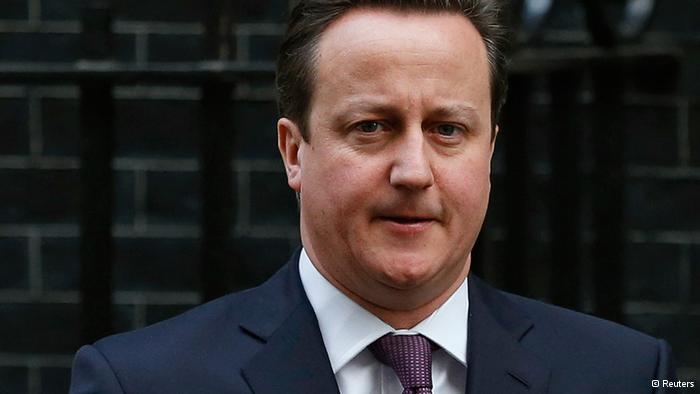
David Cameron, PM of Britain
With the basic or underlying difference still intact, it should be no surprise that the renegotiation did not go well. German Foreign Minister Guido Westerwelle said at the time that Britain should not be allowed to “cherry pick” from among the E.U. competencies only those that the state likes. What then should we make of the opt-outs at the time—provisions in which states other than Britain benefitted? Surely one size does not fit all in such a diverse federal union (that goes for the U.S. as well). Westerwelle was saying that Cameron had abused the practice that was meant as an exception rather than the rule. Britain was exploiting this means of flexibility in the Union because that people in that state tended to view the E.U. as a confederation or, worse, a trade "bloc" even though the E.U. and its states each had some governmental sovereignty. 
The president of the European Parliament, Martin Schulz, said the approach of the British government would lead to the detriment of the Union. Specifically, he warned of “piecemeal legislation, disintegration and potentially the breakup of the union” if Britain was allowed to be bound only to the E.U. competencies that the party in power in the House of Commons liked. A player joining a baseball team undermine the game even in demanding that he will only bat because that’s the only part that is fun. In higher education, the education itself could only be incomplete if students could limit their classes to what interests them. Such a player or student would essentially have a different view of the sport and education, respectively. The view itself of the nature of the thing was so at odds with the fundamentals of the thing that it would be undercut severely. This is what had been going on in the case of Britain navigating in the E.U. 
Carl Bildt, the Swedish foreign minister, also touched on the detriment to the whole from what he erroneously took to be the selfishness of a part. He said that Cameron’s notion of a flexible arrangement for his own state would lead to there being “no Europe at all. Just a mess.” French foreign minister Laurent Fabius said that “Europe a la carte” would introduce dangerous risks for Britain itself. So if the British government was being selfish, it could have been at the state's detriment, though of course I contend that selfishness does not go far enough. 
In short, the visceral reactions in other states to Cameron’s announcement manifested recognition of selfishness of one part at the expense of the whole. Those reactions were rash and, even more importantly, lacking in recognition of the underlying fault-line in the Union erupting between Britain and the Union out somewhere in the Channel. Cameron and plenty of other Brits viewed the E.U. simply a series of multilateral treaties in which sovereign states could pursue their respective interests. “What he wants, above all,” according to Deutsche Welle, “is a single market.” Therefore, he “wants to take powers back from Brussels” to return the E.U. to a network of sovereign states. It followed according to this view that each state, being fundamentally sovereign, “should be able to negotiate its level of integration in the EU.” Such would indeed be the case were the E.U. merely a bundle of multilateral international treaties, or a network to which Britain was a party, rather than a federal union of semi-sovereign states and a semi-sovereign federal level. Herein lies the real conflict of ideas within the E.U. Cameron’s strategy is selfish only from the assumption that the E.U. is something more than a network to which Britain happens to belong.
Ultimately the problem was the uneasy co-existence of the two contending conceptions of what the union was in its very essence. The real question was whether the E.U. could long exist with both conceptions being represented by different states. The negative reaction from state officials of other states who held the “modern federal” conception (i.e., dual sovereignty) of the E.U. suggests that ultimately Cameron’s conception of the E.U. was utterly incompatible with the union’s continued viability, given what it actually was at the time. 

Sources:
“EU Leaders Hit Out Over Cameron Referendum Pledge,” Deutche Welle, 23 January 2013.
“Cameron Wants Another EU,” Deutsche Welle, 24 January 2013.

Essays on Two Federal Empires, available at Amazon.

Essays on the E.U. Political Economy, available at Amazon.

Wednesday, November 8, 2017

Federalizing the Criminal Code: Racial Opportunity Costs

On December 13, 2011, a bipartisan group of legal experts told a panel of lawmakers in the U.S. House of Representatives that the federal criminal code had grown so large that U.S. citizens could not possibly keep up with it. “We ought to get rid of the old myth that you’re presumed to know the law,” Rep. John Conyers (D-Mich.) said. About 4,500 criminal statutes exist, according to Ed Meese, a former U.S. Attorney General under President Reagan. “This is in addition to over 300,000 other regulations that don’t appear in the federal code but nevertheless carry essentially criminal penalties including prison,” he said. “So the vast array of traps for the unwary that lurks out there in federal criminal law is more extensive than most people realize.” The Administrative Office of the U.S. Courts figures some 80,000 defendants are sentenced in federal court each year.
Back in the 1990s, Sandra Day O’Connor, then a justice of the U.S. Supreme Court, said at a small gathering, “Congress is acting like a state legislature.” She went on to point to all the crimes being federalized. I asked her why the Rehnquist Court had not applied the brakes to this breach of federalism. “Because it takes five,” she replied. In other words, not even the Rehnquist conservative majority, which had been responsible for the Morrison and Lopez rulings, was sufficient to arrest the ongoing political consolidation via the federalizing of criminal law.
In late 2011, Rep. F. James Sensenbrenner, chairman of the U.S. House Judiciary Committee’s panel on crime, introduced a bill that would reduce the federal criminal code by a third and define the level of criminal intent that is necessary to break the law. Laying aside the matter of Congress over-criminalizing society at the expense of liberty, and the related matter of the “micro-managing” mentality that is implied in a ceaseless desire to “mold” or control others by threatening penalties, federalism itself ought to be brought to bear on Sensenbrenner’s proposal.
Specifically, in addition to reducing the quantity of federal criminal statutes and regulations to that which the citizenry can reasonably be expected to digest, each statute and regulation should be either retained or thrown out on the basis of whether it falls within one of the enumerated powers of Congress. By “falls within,” I do not mean indirectly or by extension, as in the specious argument that an Iowa farmer’s home-grown wheat used solely by the farmer (and his family) is subject to the reach of the interstate commerce clause because if enough farmers grew wheat for their own consumption, the price of wheat transported between states would be impacted. The term expressly need not be used in the U.S. Constitution for it to be understood that the enumerated powers do not distend through sheer reasoning to preempt those powers reserved to the American republics or their residual powers. Wheat that never leaves Iowa cannot, by definition, be considered to be part of interstate commerce. I suspect that the same logic is being broken in Congressional efforts to federalize criminal law.
The U.S. Constitution clearly states that the police power resides with the states. Considering the abuses associated by state officials in implementing (or abusing) that power (e.g., California police pepper-spraying students to manipulate them off the sidewalk on a public university campus), the U.S. Government could shift from undercutting federalism by “federalizing” criminal law outside the enumerated powers to strengthening federalism by acting on a check against abusive state officials. In other words, federal criminal law could be primarily directed to the states (i.e., their officers), and to citizens secondarily and only within the powers enumerated for Congress. This approach is consistent with the confederal element that is retained in the broader notion of modern federalism (e.g., as applied in the U.S. and E.U.), while acknowledging that the general government also reaches to the citizenry directly (“direct effect”).
One example of the federal government attempting to check a systematic abuse of power by police in a state’s county is the three-year investigation by the civil rights division of the U.S. Department of Justice of the Maricopa County sheriff’s office in Arizona. The ensuing report found “a pervasive culture of discriminatory bias against Latinos” reaching Sheriff Joe Arpaio himself. Deputies are said to “target Latino drivers on the roadways and detain innocent Latinos in the community in their searches for illegal immigrants,” according to the New York Times. Such practices, according to the report, are in violation of the Fourth Amendment’s prohibition on unreasonable seizures. The report adds that Latinos have been systematically mistreated in the county jail. Besides the report, a separate federal grand jury investigation was underway as well, focusing on accusations of abuse of power by the sheriff department’s public corruption squad.
For its part, the Justice Department was urging the sheriff to cooperate with the federal government in turning his department around, or risk a lawsuit and the loss of millions of dollars in federal money. Even so, Arpaio “brushed off the criticism in a news conference as politically motivated,” according to the New York Times. He was particularly upset that the homeland security secretary, Janet Napolitano, a former Arizona governor, had announced that the federal government would no longer allow the sheriff’s deputies to check the immigration status of inmates in their custody. In reaction, the sheriff remarked, “This is a sad day for America as a whole.”
Besides the inherent impoussance of the Justice Department’s plan “to do cultural change” in a sheriff department that is headed by intransigence, the sheer time during which the alleged abuses had been allowed to continue (e.g., the report taking three years) bespeaks a woefully inadequate priority in the federal government to act as a real check on the states. To be sure, Arizona is a sovereign state with regard to its police power, and the federal government is obliged to respect that sovereignty. However, neither a government of a state nor of the union is free to violate the U.S. Constitution, which is the source of all of the governmental sovereignty that is in the federal system (characterized by dual sovereignty—split between two systems of government, that of the states and that of the union). So Arisona is not free to violate the Fourth Amendment, and the general government can legitimately provide a check, as judged by the judiciary. Therefore, rather than usurping state criminal law by federalizing criminal statues, Congress should go to work to give the federal government better tools with which to act as a check on sheriffs such as Arpaio. Generally speaking, there is more than enough for the Congress to do within its federal role without encroaching on federalism itself paradoxically by “federalizing” powers assigned to the several states. The latter activity involves an opportunity cost that I dare say the Latinos in Maricopa County doubtless do not appreciate.


Sources:
Gary Fields and John Emshwiller, “Criminal Code Is Overgrown, Legal Experts Tell Panel, Wall Street Journal, December 14, 2011. 
Marc Lacey, “U.S. Says Arizona Sheriff Shows Pervasive Bias Against Latinos,” The New York Times, December 16, 2011. 

Thursday, December 15, 2011

Leadership in Europe: A Recipe for Reducing Legal Uncertainty

Concerning the legal environment of business, the lawyers who teach as full-time instructors in American business schools affirm that managers would rather have a challenging environment that they know than one that is characterized by headlines such as, “Legal Uncertainty Imperils EU Agreement.” At the E.U.’s parliament, which represents the E.U.’s citizens, the president of the European Council, Herman Van Rompuy, said in the wake of the agreement, “An intergovernmental treaty was not my first preference, nor that of . . . most of the member states . . . It will not be easy, also legally speaking. I count on everybody to be constructive, bearing in mind what is at stake.”[1] Investors were “largely dismissive” of the Council meeting  at which the extra-E.U. agreement on strengthening the enforcement mechanism of state deficit and debt limits had been reached at the end of the previous week. Alan Brown, chief investment officer at Schroders Investment Management, which had at the time almost $300 billion under management, said of the results of the Council meeting, “Yes, it was what I expected, and yes, I was disappointed.”[2] Schroders was backing up this view with a modest bet against the euro. Relatedly, Barclays was forecasting the currency to fall from $1.30 on December 13, 2011 to $1.25 by June 2012. Besides the pessimism on the “intergovernmental treaty” as well as a possible increase of funds from the $500 billion cap on the agenda at a Council meeting in March 2012, the sheer uncertainty described by Van Rompuy lowers the value of the announced agreement and the outlook concerning the viability of the euro as well as the E.U. itself.

Federalismus in Action: Jose Barosso of the E.U. Commission and Angela Merkel of Germany / NYT

The full essay is at "Essays on the E.U. Political Economy," available at Amazon.


1. Steven Erlanger and Stephen Castle, “Europe United, Minus One: A Firm German Imprint on an E.U. Transformed,” International Herald Tribune, December 10-11, 2011. 
2. Matina Stevis, Frances Robinson, and Marcin Sobczyk, “Legal Uncertainty Imperils EU Agreement,” The Wall Street Journal, December 14, 2011; Tom Lauricella, “Euro at 11-Month Low,” The Wall Street Journal, December 14, 2011.

Monday, November 21, 2011

The African Customs Unions and the E.U.: On Currencies

The East African Community (EAC) is Africa’s “most advanced regional trade bloc,” according to The Wall Street Journal. As of the journal’s report in late 2011, the EAC was already a customs union that guaranteed the movement of goods and the right to work across Kenya, Uganda, Rwanda, Burundi and Tanzania. The parliaments were working at the time on synchronizing immigration and tariff laws. “We want to develop this corridor vigorously and collectively,” Mugo Kibati, director of a Kenyan government program, said. The journal notes, however, that the EAC and other trading blocs in Africa, such as the Southern African Development Community, were “backing away from one prominent aspect of Europe’s economic union: a common currency.” Aside from any vague similarities that the fiscal differences between Greece and Germany may have to those between Zimbabwe and South Africa, the currency question itself is out of place for a NAFTA-like trade agreement.


The full essay is at "Essays on the E.U. Political Economy," available at Amazon.


1. Patrick McGroarty, “Africa’s Goal: EuropeWithout the Currency,” The Wall Street Journal, November 21, 2011.
2. Ibid.
3. Ibid.

Wednesday, November 16, 2011

On the E.U. Debt Crisis: Lessons from the Early U.S.

In the March 2, 2010 issue of The New York Times, Roger Cohen illustrates how useful EU-US comparisons can be.[1] He is careful to compare the E.U. of his time not to the contemporaneous U.S., but, rather, to it a few decades into its founding. In other words, he corrects for the impact of time on political development. This is not to say that the E.U. in 2010 was akin to the U.S. under its Articles of Confederation. The Articles treaty evinced far less integration politically and economically. For example, whereas the Articles sported only a common council of delegates from the states, the E.U. in 2010 had a presidency (the European Council, whose president was Van Rompuy), an executive branch (the E.U. Commission, whose chief executive was Barroso), a bicameral legislature (the E.U. Council (of Ministers) and the E.U. Parliament), and a supreme court (the European Court of Justice, or ECJ). In fact, whereas under the Articles the American republics held governmental sovereignty, the ECJ held in 1963 and again in 1964 that E.U. law is supreme over state law and state constitutions. In short, whereas the Articles did not split the atom of governmental sovereignty, the E.U. in 2010 was a federal system of dual sovereignty. Like that of the U.S., the E.U.'s federal system is itself on the empire level; its republics being commensurate with the early modern kingdoms.


The complete essay is at Essays on Two Federal Empires, available at Amazon.


1. Roger Cohen, “Greece, Europe and Alexander Hamilton,” The New York Times, March 1, 2010. 

Monday, February 14, 2011

Are the EU and the US Commensurate?

Are the E.U. and U.S. commensurate? The conventional "wisdom" says no, but are most people, including most European leaders, missing something that in retrospect may be considered rather obvious? 

The full essay is at Essays on Two Federal Empires.