Showing posts with label US Government Debt. Show all posts

Wednesday, July 24, 2019

Beyond Fixing the U.S. Government's Debt

After a number of failed attempts over decades to solve a problem, it is natural that the problem itself would barely get mentioned, let alone any cure. I submit that the U.S. federal debt is a case in point. President Reagan made it an issue in 1980, and Congress has tried to mandate for itself automatic spending cuts and tax increases, but to no avail. The desire for instant gratification outstripped self-discipline. This could perhaps be said of the society generally. 
In anticipation of the “fiscal cliff” steep U.S. tax increases and budget cuts that were set to go into effect January 2013 for a decade, Moody’s Investor Service served notice to Americans and their federal government that the sequestration of $1 trillion over the ten years and the immediate end of the Bush Tax Cuts would mean a downgrade in the credit rating of the U.S. Government. The New York Times reported that the rating agency, like S&P before, “emphasized political dysfunction more than soaring government debt. The agency said that Washington must come to agreement to head off billions of dollars in simultaneous tax increases and spending cuts scheduled to begin in January—and to put the government on a sustainable fiscal trajectory. Only then would the United States keep its AAA rating.”[1] Moody’s pointed to the need for “specific policies that produce a stabilization and then [a] downward trend in the ratio of federal debt to G.D.P. over the medium term.”[2] 

Moody's Investor Services     (Reuters)
Significant reductions in spending over ten years, plus an immediate end of the tax-rate reductions that George W. Bush had signed into law, would presumably have produced a downward trend in the ratio of federal debt to G.D.P. over the medium as well as long term unless a recessionary impact would be such as to counter the effect from the sequestration and tax increases. Pressure would have built to exempt spending on unemployment compensation and other sustenance programs, while the tax revenue would have fallen short. In other words, the sequestration, had it been allowed, would not have been a sure thing in reducing the federal debt. 
As of June, 2019, the debt stood at over $22 trillion. The will in a democratic system to take corrective action can be so deficient that a serious problem can get much worse. Whereas the rating agencies were ready to downgrade the U.S. Government's credit rating when the debt stood at $16.7 trillion, no such warning went up six years later when the debt was substantially more and no hint of any sequestration was in the air. 
Ronald Reagan had made balancing the federal budget a salient part of his 1980 platform, though once in office he pushed for tax cuts and increases in defense spending that undercut prospects for a balanced budget. The experiment in whether cutting taxes could actually boost tax revenue due to more economic activity failed. In 2013, sequestration failed even to launch. It is no wonder that as the debt passed the $20 trillion mark, the political discourse had given up on a cure. That such a debt might be too big to be paid off, that the U.S. Government was de facto already out of reach, was never mentioned even in conversation. 


1. Jonathan Weisman, “Moody’s Warns That U.S. May Face Debt Downgrade,” The New York Times, September 12, 2012.
2. Ibid.

Saturday, October 27, 2018

The Debt-Ceiling and the U.S. Budget as Ransom: A Structural Flaw of Democracy?

It is likely a drawback of democracy that hard decisions—that is, those in which fixing the problem goes against instant gratification or financial advantage—get pushed back, or “kicked down the road,” rather than addressed in a definitive way such that difficult problems are fixed. This structural problem can be seen in how Congressional leaders and the U.S. President delayed the “fiscal cliff” for two months at the beginning of 2013. More generally, the political tactic of holding the federal budget and the debt-ceiling as ransom evinces a fundamental flaw in democracy itself.
To be sure, excesses in politics were also in the mix, as each side stepped back from closing deals when presented with a more opportunistic bargaining standpoint in doing so. For example, President Obama suddenly added $400 billion more in revenue to his “grand bargain” with Speaker Boehner when the bipartisan “gang of six” in the U.S. Senate announced their own deal, which included more revenue than was in the “grand bargain.” Put another way, Obama got greedy and undercut his own credibility in terms of sticking to a deal that he had led the Speaker to believe had been achieved. Later, as conservative Republican pressure mounted on the Speaker, he walked away from even the “grand bargain” without the $400 billion more in revenue on the table. The result was frustration, distrust, and a “quick fix” that merely “kicked the can down the road” and unnerved markets with the prospect of ongoing uncertainty. At the very least, the trajectory bespoke the dysfunction rather than triumph of politics. More subtly, the verdict on representative democracy could not have been good. Although less transparent, this observation is far more serious, for no alternative to democracy could claim superiority even given the vulnerabilities in self-government.
Behind the leaders’ “inability” to reach a “grand bargain” capable of solving structural budgetary imbalances (beyond those which come from simply “digesting” the aging of the baby-boom) was pressure from competing ideologies on the size/role of government held within the electorate itself. Reconciling such distant ideologies can be difficult even in terms of reconciling visionary leadership;  deal-making is likely more oriented to a more micro level of policy.
The Speaker had been wise in wanting to do something much bigger in the “grand bargain” than merely getting the country’s debt ceiling raised and making a dent in the budget deficit. He had wanted fundamental tax and entitlements reform that would put the U.S. Government on the path to fiscal balance. “I did not come here to have a big title,” he said. “I came here to do big things.” Indeed, he put his title as Speaker at risk just by negotiating with the President with revenues on the table, given the emergence of the anti-tax “Tea-Party” Republicans in the House Republican caucus.
Upping the ante, as it were, was the choice made by Rep. Paul Ryan (R-WI) to use the debt-ceiling vote as leverage to extract concessions from the White House. According to The New York Times, “Republicans vowed to use the need to raise the federal debt ceiling in early 2013 to force deeper spending reductions before agreeing to an extension until May.” Making passage of an increase in the ceiling in some sense contingent was itself destabilizing to the market due to the new uncertainty on whether the U.S. Government would default. Additional uncertainty in the business environment translates into a business reducing or putting off investments in expanding operations. The announcement itself added risk to U.S. Treasury bonds, even if the strategy would not actually go as far as actually standing by as the United States Treasury defaults on its obligations.
In reaction to Rep. Ryan’s announcement, Tim Geithner, Secretary of the U.S. Treasury, advised the President to make a deal because a default on Treasuries would trigger not only a significant downgrade in the nation’s debt rating, but also another Great Depression that would take generations to run its course. Even if Ryan’s negotiation strategy of “hold no prisoners” is very clever in a narrow sense of politics, it is difficult to accept the “ends justifies the means” justification for even opening up the mere possibility of another Great Depression. In other words, even great political strategy can raise red flags if the country itself is put at catastrophic economic risk even for a time. It makes sense that the American Founders viewed partisanship so negatively, even if the Federalists and Anti-federalists could be as partisan as they come. Being willing to up the ante without limit in terms of the risk of harm to the whole may be part of an escalation of ideological passion that eclipses common sense and eventually sinks the entire ship. An observer from Mars might get the idea that the humans over here are getting more desperate. Given the sheer ideological distance between the competing visions at issue, using something as catastrophic as not raising the debt ceiling as leverage can reasonably be regarded as reckless, if not foolish, even if the political calculus is cleaver and even ultimately effective in terms of the ideological objectives.
Fortunately (relative to having the debt-ceiling as leverage), the minority leader and the president of the U.S. Senate came up with a “fiscal cliff” to effectively replace the debt-ceiling as leverage. Even though legislative patrons of various parts of the federal budget claimed that the across-the-board cuts, or sequestration, would devastate the particular departments or programs, “going over” the “fiscal cliff” would be preferable to even risking the U.S. going into default. In other words, the move to something less catastrophic in what a partisan is threatening if he doesn’t get what he wants represents a ray of sanity in an otherwise insane escalation in systemic risk.
To be sure, the media had made sequestration sound like the U.S. Government would be paralyzed and the sky would fall. The economic fear and uncertainty unleashed by the hyperbolic rhetoric are perhaps more harmful than the actual “cuts” would be. The across-the-board “cuts” scheduled to go into effect on March 2, 2013 absent a deficit-reduction law in the meantime total $85 billion. This is a mere sliver in a budget of more than $3.5 trillion. Indeed, the “cuts” are less  in total than the last annual increase in the budget—far from likely to send the U.S. economy into recession.
According to the Fiscal Year 2012 Mid-Session Review, the enacted 2011 budget called for $3.63 trillion in outlays. The enacted 2012 budget called for $3.796 trillion in outlays, according to the Office of Management and Budget. The annual increase, $166 billion, is almost twice as much as the $85 billion at issue in the threatened sequester for March through December 2013. Put another way, the sequester’s cuts for 2013 beginning on March 2nd equal about half of the increase in the budget from FY2011 to FY2012.
The reckless nature of the sequestration is not in taking back half of the last annual increase. In fact, the total amount of outlays would still steadily increase throughout the ten year period that is subject to sequestration.
Rather, the craziness pertains to two points. First, although the $85 billion is less than half of the prior year’s increase in the budget, the sequestered amount would not apply, according to the Congressional Budget Office, to about 70% of mandatory spending. That mandatory spending, such as social security, medicare and Medicaid, made up about two-thirds of the budget at the time. It follows that sequestration would not touch 47% of the federal budget. This means that for the remaining 53 percent, the reduction would go deeper than the increases in those categories, or “buckets,” from the prior year. In other words, about half of the budget would take on the full weight of the sequester, hence the “cuts” there really would be cuts (i.e., going beyond removing the increase from the prior year). Reports of suspended public services, such as air traffic control at some 100 smaller airports, could thus be expected even though in total the sequester amount is about half of the total budget increase from the prior year.
It would be like adding an additional product to an already-loaded caravan of camels crossing a desert. The caravan could easily absorb the addition, except that the decision is made to put the additional weight onto about half of the camels. From the strain on those camels, an observer might easily conclude that the additional product is too much for the caravan itself. Any question of adding still another product would be dismissed out of hand even though the further addition is feasible and would make the caravan profitable.
Second, each “budgetary bucket” in the 53% of the federal budget subject to the sequestration would face the same percentage or “automatic” reduction, regardless of how vital the particular bucket happens to be. A department could not shift its “cuts” from payroll, for example, to conferences, to avoid layoffs. Put another way, all of the buckets in a given department would have be treated the same way in the sequestration (i.e., automatic, across-the-board). As a result, even just $85 billion out of $3.5 trillion could result in significant layoffs.
From the standpoint of achieving fiscal balance, it could be argued that even more should be cut, or some additional combination of additional revenue and “cuts” going beyond a total amount that merely removes about half of the annual increase in the budget from the prior year.  However, this point would doubtless pale in comparison with the real cuts to the budget buckets subject to sequestration. The way the sequestration is designed implies or gives rise to a perception of severity that is not the case on the macro level, and this perception can arrest any movement to bring spending and revenue further into line. Put another way, the way the sequestration approaches the federal budget makes it more difficult to bring enough political will to “finishing the job” in ending structural deficits and not merely narrowing them.
In conclusion, using the debt-ceiling and sequestration as leverage are not really comparable from the standpoint of actual (rather than media-hyped) harm to the United States. The harm from sequestration applies only to certain “buckets”; the overall “hit” being merely taking back some of the increase from the prior year’s budget. In contrast, the failure to increase the debt-ceiling to the extent that Treasury can avoid default gives rise to the systemic harm of a governmental default. Perceptions notwithstanding, the particular harms from the sequestration are qualitatively and quantitatively different. Accordingly, the move from the debt-ceiling to sequestration as political leverage represents a bright spot on what otherwise looks like democracy being utterly incapable of tackling fundamental problems facing a republic. To be sure, the obsessive fixation on “revenue vs. cuts” contributes to the limited perspective that prevents more fundamental solutions from entering even into public deliberation and discourse. Generally speaking, we the people are holding ourselves back even from being aware of more far-reaching proposals because of the distortions in the media’s “reporting” (or opining) as well as in the design of the sequestration itself. The fundamental question is whether such “holding back” is intrinsic to self-governance of and by the People.

Source:

Cliffhanger,” Frontline, PBS, February 11, 2013.

Cavuto, Neil “Sequestration Really the End of the World?” Fox News. 20 February 2013.

Thursday, October 4, 2018

U.S.Budget Deficits: Of Virtue or Vice?

Chronic government fiscal deficits, and thus debt, may suggest that a people is not up to self-governance. Moreover, the imbalance may be a drawback of democracy itself. That is to say, a people may not have sufficient will to constrain its own consumption to that which the people are willing to pay.
 

In the period from 1970 to 2012, that the vast majority of the years show a deficit indicates the difficulty involved in elected representatives voting to ensure that the people pay in taxes as much or more than the government spends. “It’s an extraordinarily dangerous situation,” former Federal Reserve Chairman Alan Greenspan said in 2012. “I believe we underestimate the size of current financial imbalances and how difficult it will be to resolve them. We’re trying to do this without pain. There’s just no credible scenario in which that happens.” The key phrase here is “without pain,” for it points to the underlying mentality that was pushing back a viable solution. To be sure, both the widening deficits and lack of desire to close the gaps from 2009 could draw on Keynes’ theory that governments should spend more and tax less during a recession in order to stimulate economic growth. However, the sheer number of years between 1970 and 2012 with significant deficits in terms of GDP suggests that the rationale has at best limited applicability. Even in the context of recession, the fact that the deficits were over $1 trillion in each of the four years after 2008 suggests that something else is in the mix. Nor could “wartime spending” be cited for those deficits, as significant domestic spending was also involved. Moreover, the U.S. was not at war during all the years of deficit spending from 1970 to 2012. In other words, something more systemic was going on throughout the period than recession or war.
According to the Wall Street Journal, the federal debt in the U.S. grew “through a combination of economic downturns, tax cuts and spending choices made by lawmakers and presidents from both parties.” It is not a partisan matter; rather, it involves choices made by elected representatives irrespective of party-affiliation. For this reason, we can begin to suspect democracy itself as the culprit, and below this the values and mentality (and indeed character) of the voters. In particular, too many are too fine with spending or consuming without feeling the need to pay for it in a timely manner. This is ultimately a question of values behind one’s character. At the political level, this manifests as societal or cultural in nature; even so, the imbalance is really in the individual psyche itself.
The vice is one of slothful selfishness at the expense of others—those in the future who will ultimately either have to pay the bill or see the government default. It is significant in this regard that Thomas Jefferson and John Adams agreed that a virtuous citizenry is necessary for a viable republic to endure. The question is perhaps what happens to it once a citizenry is no longer virtuous. Collapse even from a fundamental lack of fiscal balance can be stayed by the inertia of the status quo, as though a ship kept moving by its own momentum for a considerable time. In the soothing motion, the passengers can easily be lulled into the sensation that all is well.
 

Source: Damian Paletta, “Tough Calls on Deficit Await the Winner,” The Wall Street Journal, November 6, 2012.

Tuesday, February 13, 2018

Instant Gratification Rules in American Fiscal Policy


With an expected deficit of $1.2 trillion for 2018-2019, the U.S. Government in December, 2017 enacted a tax cut with an expected revenue loss of nearly $1 trillion over a decade (assuming some growth from the tax stimulus) and, two months later, a budget deal passed adding $300 billion to federal spending in the next fiscal year.[1] All this was done with the U.S. debt at over $20 trillion—higher than the annual GDP at the time. With the  economy humming along with a low unemployment rate, the prospect for any fiscal discipline was bleak. Put another way, if budget surpluses could not come at the boom end of an economic cycle, then deficits would be likely in good times and bad. Behind the structural imbalance of contiguous deficits and an ever-growing debt is the all-too-human preference for instant gratification without a corresponding value being placed on self-discipline.
In a republic, the electorate elects representatives in part because direct democracy has no constraint on the immediate passions of a people. In the case of the U.S. Congress and White House,  the representatives had not by 2018 at least resisted the instinct for immediate benefit for the good of the American republics and their peoples—which together constitute the United States. Thomas Jefferson and John Adams agreed in retirement that an educated and virtuous citizenry is vital to a viable republic. The $20 trillion federal debt reflects back on Americans not in a good way in this respect.
For a republic—including one that is also a federation of republics—to be viable over the long term, some allowance for the long term must be made in the form of fiscal discipline. This is essentially self-discipline on a societal level. In the case of the tax cut and additional federal spending, Americans could “expect some of the strongest economic growth” in years.[2] This made the urge for instant gratification particularly alluring. In the medium term, Americans would face “more risk of surging inflation and higher interest rates—fears that were behind a steep stock market sell-off” in early February, 2018.[3] Notice that the negatives begin only in the medium term; hence they do not detract from the instant gratification. In the long term, the U.S. could have less flexibility fiscally in enacting a stimulus to combat a recession or even a crisis like that which had hit Wall Street in September, 2008. Additionally, “higher interest payments could prove a burden on the federal Treasury and on economic growth.”[4] The short term boost in an already booming economy could be expected at the time to hamper economic growth perhaps at a time of recession! Yet the force of this anticipation had no power in the enacting of the tax cut and additional spending. Knowledge, it appears, requires virtue manifesting as self-discipline. That it was missing reflects especially on the elected representatives of both parties, but also on the American electorate that elects and re-elects those representatives with impunity.


[1] Neil Irwin, “Austerity Era Comes to End,” The New York Times, February 10, 2018.
[2] Ibid.
[3] Ibid.
[4] Ibid.

Friday, August 18, 2017

Pressuring Employees to Act as Lobbyists on the U.S. Debt: Ethical?

How far a boss can ethically become involved in an employee’s political role as a citizen is a question perhaps more important than whether a business should make demands regarding what an employee does in the privacy of his or her own home (e.g., smoking or drinking products that are legal). It would obviously be objected, for example, were a supervisor to insist on accompanying a subordinate into the voting booth to verify the vote. What about pressuring an employee to lobby as a private citizen in the company’s interest without being paid for that work? Is it even work when it is “voluntarily” done on “off-time”? Finally, would it make a difference if the issue held systemic importance—meaning if it were vital to the country itself or at least the economic system—and the particular stance being advocated by the boss had value in solving the systemic problem (i.e., not just in the company’s interest)?
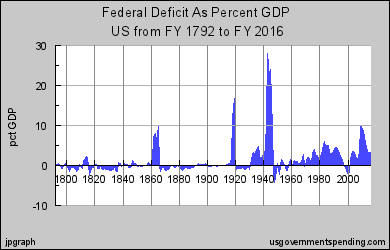
Federal U.S. deficits as a percentage of GDP from 1792 (2012-2016 projected). Notice that the projections take the deficits down from 2008-2010 levels. Notice also 1960-2010 as differing significantly from the "episodic" pattern in the 1792-1930 period. Why?
As 2012 wound down, Congress and the American president found themselves embroiled in difficult negotiations to avoid the across-the-board budget cuts and the end of the Bush tax-breaks scheduled to begin with the new year. Both sides were using the media to (over)dramatize what was at stake, even calling the scheduled deficit-reduction a “fiscal cliff”—as if $500 billion in 2013 out of an economy of annual GDP of over $16 trillion were a cliff rather than an impediment to growth. Into that hypertrophy, CEO’s were making their positions known in meetings with Congressional leaders and the president.
Morgan Stanley’s CEO, James Gorman, sent an email to his company’s 16,000 financial advisors and branch managers in the U.S. urging them to contact their members of Congress to urge them to reach “a bipartisan compromise” on a deficit-reduction deal that would override the across-the-board cuts and the end of the tax breaks across all income levels subject to federal income tax. “No issue is more critical right now for the U.S. economy, the global financial markets and the financial well-being of our clients,” he wrote, “which is why I am asking you to participate in the democratic process and make your voice heard.” The CEOs of Caterpiller and Honeywell International also urged their respective employees to pressure their representatives in Congress to reach a compromise.
On the one hand, that Gorman explicitly asks his employees to participate suggests that the request is extrinsic to the employees’ jobs. No employee could be penalized for refusing, and the CEO did not have the right to verify a particular employee’s “participation.” Moreover, participation in the democratic process pertains to citizens, and is thus extrinsic to the role of employee at a company. That is to say, it could be argued that a boss has no business involving himself what, if anything, an employee does in the democratic process—that domain being off limits. The pressuring could be viewed in terms of that process as one citizen trying to pressure others to do his will politically—something any citizen on the receiving end has a right to be without. This stance can be modified, or mediated, however, by the substance of the request.
That no “issue is more critical right now for the U.S. economy [and] the global financial markets” means that the value of the request is not merely to the company or even its customers—there is a larger stake involved. The larger element implies a civic duty of sorts, which even CEOs—being human after all—can feel and act on with a sense of higher calling than merely protecting their jobs and companies. Were an asteroid heading for Earth, no one would complain should the CEO of even an asteroid-destruction company urge his or her employees to pressure members of Congress to act on the threat—even if it would mean that the company gets a lucrative contract as a result. Of course, if the “fiscal cliff” rhetoric were outsized relative to the actual threat at hand, the play for democratic participation would be over-played from this standpoint and employees should feel any civic obligation in turn. In fact, employees could refuse their CEO’s request as a way of “just saying NO” to the constructed theatrics in Washington.
Beyond the question of “higher purpose,” the substance of the CEO’s favored remedy is also relevant to whether he or she is “crossing the line.” In general, the more partisan the intimated or explicit recommendation to be lobbied, the more suspect the attempt to pressure employees to participate in the democratic process on the issue at hand. Gorman was on pretty solid ground in this respect, urging only that a bipartisan deal be reached. Better still, he could have suggested that employees use their own judgment in recommending particular solutions but urge their members of Congress to be sure to come to a deal at the end of the day.
However, if the “fiscal cliff” rhetoric was exaggerated theatrics designed by politicians to get more attention, Gorman’s assumption that the important thing was that a deal be reached could have been wrong. From the standpoint of reducing the federal deficit in 2013, the “cliff” could be preferable to any deal likely to come at the end of 2012. Such a deal could be a two-parter that would have less overall impact on the deficit. In this case, Gorman should have urged his employees to pressure their federal representatives not to compromise on deficit-reduction, even if that means “going over the cliff.”
Perhaps the least legitimate plea for participation is that which is highly partisan or self-serving. Were Gorman to urge employees to support President Obama’s position on tax rates, for example, the employees could rightly object to their boss’s interference into their politics. As an example of a self-serving position, Lloyd Blankfein—the CEO of Goldman Sachs who had told a journalist that Goldman was doing “God’s work”—was urging Congress to cut entitlement programs to the poor while retaining subsidies (including in taxation) for business including Goldman Sachs. He told CBS, “You’re going to have to do something, undoubtedly, to lower people’s expectations of what they’re going to get.” Of course, the Wall Street executive was referring to other people.
Blankfein was taking part in the “Fix the Debt” group, the CEO members of which were publicly urging cuts to Social Security, Medicare and Medicaid to reduce the federal deficit for 2013. Whereas those CEOs had amassed personal retirement assets averaging more than $9.1 million, less than 60 percent of the publicly-traded companies represented offered pension plans for their employees at the time. Of the 41 companies that did, the Huffington Post reports that 39 of them had not contributed enough to their workers’ pension funds to enable the plans to pay out their anticipated obligations. For the CEOs to be advocating austerity for others—while the executives’ own companies slacked on pensions for their employees even as they received government subsidies (including tax deductions)—without also advocating austerity for themselves—such as by reducing subsidies to business and corporate deductions—goes beyond garden-variety selfishness to include a certain callousness toward others. Were those CEOs also pressuring their employees to “participate in the democratic process” to “Fix the Debt,” those employees would have been fully justified ethically and politically to “just say NO.”
Besides the point that those who can afford to do with less should not demur from placing their chits on the table too when it comes to reducing the deficit, cutting sustenance-benefits from the most vulnerable could be argued to be ethically unfair, if not sociopathic, particularly from the perspective of Rawls’ theory of justice. From the standpoint of this theory, Blankfein’s prescription is simply a reflection of his standpoint. It follows that employees could justifiably object to pressure from Blankfein to “participate in the democratic process” so the bank could continue to get its subsidies while citizens who are the most vulnerable, including fired bankers whose unemployment compensation expires, take the hit.

In short, a boss urging his or her employees to participate in the democratic process is a controversial question. Generally speaking, employers should regard their employees’ democratic participation as being in another domain from that of their work. More generally, that which pertains to a person’s employment role should not encroach onto other domains in a person’s life, and an employer should respect the limitations. However, extenuating circumstances can modify or mediate this stance. Most significantly, the more dire a problem is to the system as a whole, the more legitimacy a boss has in encouraging employees to “participate” in a solution. However, even in such a context, the more partisan and/or self-serving the stance being advocated is, the less legitimacy the employer has in applying the pressure.

Sources:

Damian Paletta and Kristina Peterson, “CEOs Flock to Capital to Avert ‘Cliff,” The Wall Street Journal, November 28, 2012.

Christina Wilkie, “’Fix The Debt’ CEOs Underfund Employee Retirement, Demand Cuts For Elderly,” The Huffington Post, November 27, 2012.

Ethan Rome, “Goldman Sachs CEO Lloyd Blankfein Wants Seniors to Get Less,” The Huffington Post, November 27, 2012.

Tuesday, February 1, 2011

The Federal Reserve to Buy More U.S. T-Bills but No State Debt

According to The New York Times, “At their first meeting of the year, Federal Reserve policy makers voted unanimously … to continue the central bank’s controversial $600 billion plan to spur the recovery by buying government bonds.”[1] In other words, the central bank would continue to “print money” to buy up U.S. Government debt, allowing that government to go into more debt without putting pressure on the interest rate to go up (which would cost the government more in interest payments to bondholders).

Theoretically, the Federal Reserve can buy an unlimited amount of bonds because the central bank can create money. Of course, creating money relative to GNP growth can spark inflation, but the central bankers are not worries. “The Fed did note that commodity prices had risen, but cautioned that long-term inflation expectations had been stable and that measures of underlying inflation had continued to trend downward.” Even so, “skeptics fear that the bond-buying — which has the effect of further expanding the Fed’s already large balance sheet — could lead to destabilizing asset bubbles or touch off inflation.”[2] I contend that this is a rather narrow (though certainly valid) concern; equally or more troubling for the long term is the asymetry in the Fed’s treatment of debt issued by the U.S. Government and that of the state governments. 

For instance, in 2010 Illinois issued $16 billion in additional debt. Whereas the U.S.Government could fall back on the Federal Reserve, the latter has refused to purchase debt from states like Illinois. Aside from the unfairness inherent in the Federal Reserve’s proclivity, the asymetry subtly undercuts federalism. In other words, the U.S. Government having an unlimited ability to have its central bank purchase its debt gives that government still another edge over the state governments, which one can expect will be even more compromised in being able to check encroachments by the U.S. Government. The resulting enervation of federalism means that consolidation may reach us sooner rather than later, at the expense of our governments being able to act as mutual checks on eachother.

Another way of making this point is to charge that the Federal Reserve’s refusal to do for the state governments what the central bank is doing for the U.S. Government evinces a structural bias in our system of federalism. The lack of balance (and the underlying unfairness) ought to be of concern to the citizenry. The result may well be that the U.S. Government will be enabled to get into unsustainable debt such that the empire itself may one day collapse under its own weight at the center.

1. Sewell Chan, "Fed to Continue Bond Buying Program," The New York Times, January 26, 2011.
2. Ibid.

Wednesday, December 15, 2010

Military Sacred Cows: A Matter of Contrived Camulflage

"The most significant threat to our national security is our debt."

Micheal Mullen, Jount Chiefs of Staff Chairman, August, 2010.

The defense budget in 2010--$664 billion (not counting the Iraq and Afghanistan wars)--equalled that of the rest of the world combined.  One dollar of every five spent by the U.S. Government was for defense. The amount spent represents 80% growth since 2000. Why?  One reason: the big weapon systems oriented to fighting other empires (e.g., Russia and China). For example, $600 million for the littoral combat ship and $13 billion for amphibious landing vehicles (whose purpose has even been questioned by Sec. of Defense William Gates).  It would seem that the military contractors--the military industrial complex, moreover--are firmly entrenched and in control. That is to say, the defense spending is indicative of the influence of big business over government in the United States.  That this influence goes unhampered may tell us something about the leanings of our societal norms.

The House Republicans' "Pledge to America" formulated in 2010 promises to exempt the military from any cost-cutting that might be entailed in reducing deficit spending. Even so, Sen. Tom Coburn wrote, "Taking defense spending off the table is indefensible. We need to protect our nation, not the Pentagon's sacred cows."  This statement is significant because it gets at the problem of the debt and the influence of big business in government.  That is to say, it kills two birds with one stone.  Indeed, these two birds may well be the achilles heel of the United States as a viable entity or going concern.  The fatal flaw may well be within, rather than from an external threat.  This is the meaning of Micheal Mullen's statement above. To be sure, Republicans believe that defense is government's core function. Along with regulating interstate commerce, this is particularly true of the federal government.  It is less true, I would argue, of the state governments.  So the plank can be viewed as primarily federalist rather than in terms of limited government itself.  The probably-unfixable $14 tillion US Government debt and the consolidation of public governance in the U.S. into the federal government at the expense of federalism (and the checks therein) are related; both are indications of a basic inbalance that is unsustainable. In the face of this state of affairs, it is telling that the question in late 2010 was who should continue to get a tax.


Source: Michael Crowley, "The Sacred Cows," Time, December 13, 2010, pp. 55-58.