Friday, August 18, 2017

The U.S. House of Representatives: An Aristocratic Democracy-Deficit?

The abrupt resignation of Jesse Jackson, Jr., from the U.S. House of Representatives in 2012 only weeks after being re-elected gave Democratic politicians in Chicago a rare opportunity to get their hands on a Congressional seat. The New York Times observed at the time that such seats “in Democratic strongholds” of Chicago “do not come open very often, and when they do, a line forms fast.” According to Debbie Halvorson, who ran against Jackson, “If someone is thinking of becoming a congresswoman or congressman, this might be their only chance. Whoever gets this will have it forever, they say. That’s why everyone wants to take a chance.” In other words, the office is a sort of personal entitlement. From a democratic standpoint, this represents “slippage.”

The reason for the two-year term in the U.S. House is to render the representatives responsive to their respective electorates or constituents. The six-year term in the U.S. Senate was chosen for precisely the opposite reason—that such a term would give the senators some breathing room from the “real-time” demands of their respective states. The bicameral result would ideally be a check and balance of the people’s momentary passions and deliberation on the country’s best interests beyond today. Having a House seat “forever” renders its occupant immune, at least potentially, from having to respond legislatively to contemporary demands “back home.” Indeed, having the job for life, an incumbent might even move to Washington, D.C., with only occasional visits “back home.” With only 435 members representing a combined population of about 310 million (as of 2012), the U.S. House is already aristocratic in nature; a re-election rate for incumbents up for re-election of over 90% and certain seats being virtually life-time appointments render the “people’s House” akin to a House of Lords.

Because the U.S. Senate was intended to represent the propertied interest as well as the states, an aristocratic House gives the elite too much institutional power in the U.S. Government. Other things equal, the democratic element—that of the people—will in theory eventually revolt. Were the imbalance in favor of the masses, the propertied would soon “opt out” too. Hence, the delegates at the U.S. constitutional convention in 1787 intentionally fashioned a federal government reflecting “the one, the few, and the many” in a sort of balance.

The U.S. President is “the one”—the antecedent being the imperial monarch. The U.S. Senate and the U.S. Supreme Court both refer to “the few.” The U.S. House, being at first the sole repository of democracy in the U.S. Government, was to represent “the many.” As in juggling, if one ball joins one of the others rather than there being three separated equidistantly, the balance is off and all of the balls are likely to be dropped. At the very least, the pernicious impact of the imbalance can be lessened by shifting domains of authority back to the governments of the member-states.

                                    Even though the U.S. House Chamber looks large, it represents 310 million people.   Source: Britannica

Additionally, the U.S. House could be enlarged to the size of the European Parliament—both containing representatives of a people spanning an empire in scope. Lest it be concluded that such a size is nonetheless unwieldy for a legislative body, it could be argued that the “extended republic” has become too big for even a “repository of democracy,” in which case we are back to the notion that power could be transferred back to the states—many of which have populations equal to or exceeding that of the United States when the U.S. Constitution was formulated and ratified.

Accordingly, several of the states might consider adopting federalism—the states’ “states” (i.e., provinces, “countries” (in UK), cantons, or lander in European terms) might be as the early state legislatures were in the early United States (i.e.., citizen representatives serving for a time). Put another way, the large and medium republics in the U.S. as of the end of the twentieth century at least may themselves be commensurate with the early U.S. as a whole from the standpoint of population and representative democracy. Even so, the diversity within a given state is not as great as that which exists even in 2012 from state to state. Europeans who travel from New York to Miami and on to San Francisco and maybe Utah discover that the United States do indeed differ cultural, albeit in different ways perhaps than the member-states do at home in the European Union. Even though less diverse internally than interstate, some of the United States are internally diverse enough—and populous enough—to warrant the application of federalism to those republics such that legislatures covering a number of counties could be formed and given a portion of the state’s remaining sovereignty. Just as the E.U. deals directly with regions of states, the U.S. could as well.

In short, the U.S. House of Representatives, being in many respects an aristocratic body—the advent of which some of the founders, particularly the anti-federalists, anticipated back in 1787—enlarging that chamber democratically AND extending federalism down into the states could lessen the democratic deficit in the system overall.  

Source:
Steven Yaccino and Monica Davey, “Illinois Sets Election Dates to Replace Jackson in House,” The New York Times, November 27, 2012.

Pressuring Employees to Act as Lobbyists on the U.S. Debt: Ethical?

How far a boss can ethically become involved in an employee’s political role as a citizen is a question perhaps more important than whether a business should make demands regarding what an employee does in the privacy of his or her own home (e.g., smoking or drinking products that are legal). It would obviously be objected, for example, were a supervisor to insist on accompanying a subordinate into the voting booth to verify the vote. What about pressuring an employee to lobby as a private citizen in the company’s interest without being paid for that work? Is it even work when it is “voluntarily” done on “off-time”? Finally, would it make a difference if the issue held systemic importance—meaning if it were vital to the country itself or at least the economic system—and the particular stance being advocated by the boss had value in solving the systemic problem (i.e., not just in the company’s interest)?
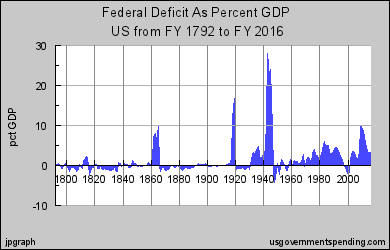
Federal U.S. deficits as a percentage of GDP from 1792 (2012-2016 projected). Notice that the projections take the deficits down from 2008-2010 levels. Notice also 1960-2010 as differing significantly from the "episodic" pattern in the 1792-1930 period. Why?
As 2012 wound down, Congress and the American president found themselves embroiled in difficult negotiations to avoid the across-the-board budget cuts and the end of the Bush tax-breaks scheduled to begin with the new year. Both sides were using the media to (over)dramatize what was at stake, even calling the scheduled deficit-reduction a “fiscal cliff”—as if $500 billion in 2013 out of an economy of annual GDP of over $16 trillion were a cliff rather than an impediment to growth. Into that hypertrophy, CEO’s were making their positions known in meetings with Congressional leaders and the president.
Morgan Stanley’s CEO, James Gorman, sent an email to his company’s 16,000 financial advisors and branch managers in the U.S. urging them to contact their members of Congress to urge them to reach “a bipartisan compromise” on a deficit-reduction deal that would override the across-the-board cuts and the end of the tax breaks across all income levels subject to federal income tax. “No issue is more critical right now for the U.S. economy, the global financial markets and the financial well-being of our clients,” he wrote, “which is why I am asking you to participate in the democratic process and make your voice heard.” The CEOs of Caterpiller and Honeywell International also urged their respective employees to pressure their representatives in Congress to reach a compromise.
On the one hand, that Gorman explicitly asks his employees to participate suggests that the request is extrinsic to the employees’ jobs. No employee could be penalized for refusing, and the CEO did not have the right to verify a particular employee’s “participation.” Moreover, participation in the democratic process pertains to citizens, and is thus extrinsic to the role of employee at a company. That is to say, it could be argued that a boss has no business involving himself what, if anything, an employee does in the democratic process—that domain being off limits. The pressuring could be viewed in terms of that process as one citizen trying to pressure others to do his will politically—something any citizen on the receiving end has a right to be without. This stance can be modified, or mediated, however, by the substance of the request.
That no “issue is more critical right now for the U.S. economy [and] the global financial markets” means that the value of the request is not merely to the company or even its customers—there is a larger stake involved. The larger element implies a civic duty of sorts, which even CEOs—being human after all—can feel and act on with a sense of higher calling than merely protecting their jobs and companies. Were an asteroid heading for Earth, no one would complain should the CEO of even an asteroid-destruction company urge his or her employees to pressure members of Congress to act on the threat—even if it would mean that the company gets a lucrative contract as a result. Of course, if the “fiscal cliff” rhetoric were outsized relative to the actual threat at hand, the play for democratic participation would be over-played from this standpoint and employees should feel any civic obligation in turn. In fact, employees could refuse their CEO’s request as a way of “just saying NO” to the constructed theatrics in Washington.
Beyond the question of “higher purpose,” the substance of the CEO’s favored remedy is also relevant to whether he or she is “crossing the line.” In general, the more partisan the intimated or explicit recommendation to be lobbied, the more suspect the attempt to pressure employees to participate in the democratic process on the issue at hand. Gorman was on pretty solid ground in this respect, urging only that a bipartisan deal be reached. Better still, he could have suggested that employees use their own judgment in recommending particular solutions but urge their members of Congress to be sure to come to a deal at the end of the day.
However, if the “fiscal cliff” rhetoric was exaggerated theatrics designed by politicians to get more attention, Gorman’s assumption that the important thing was that a deal be reached could have been wrong. From the standpoint of reducing the federal deficit in 2013, the “cliff” could be preferable to any deal likely to come at the end of 2012. Such a deal could be a two-parter that would have less overall impact on the deficit. In this case, Gorman should have urged his employees to pressure their federal representatives not to compromise on deficit-reduction, even if that means “going over the cliff.”
Perhaps the least legitimate plea for participation is that which is highly partisan or self-serving. Were Gorman to urge employees to support President Obama’s position on tax rates, for example, the employees could rightly object to their boss’s interference into their politics. As an example of a self-serving position, Lloyd Blankfein—the CEO of Goldman Sachs who had told a journalist that Goldman was doing “God’s work”—was urging Congress to cut entitlement programs to the poor while retaining subsidies (including in taxation) for business including Goldman Sachs. He told CBS, “You’re going to have to do something, undoubtedly, to lower people’s expectations of what they’re going to get.” Of course, the Wall Street executive was referring to other people.
Blankfein was taking part in the “Fix the Debt” group, the CEO members of which were publicly urging cuts to Social Security, Medicare and Medicaid to reduce the federal deficit for 2013. Whereas those CEOs had amassed personal retirement assets averaging more than $9.1 million, less than 60 percent of the publicly-traded companies represented offered pension plans for their employees at the time. Of the 41 companies that did, the Huffington Post reports that 39 of them had not contributed enough to their workers’ pension funds to enable the plans to pay out their anticipated obligations. For the CEOs to be advocating austerity for others—while the executives’ own companies slacked on pensions for their employees even as they received government subsidies (including tax deductions)—without also advocating austerity for themselves—such as by reducing subsidies to business and corporate deductions—goes beyond garden-variety selfishness to include a certain callousness toward others. Were those CEOs also pressuring their employees to “participate in the democratic process” to “Fix the Debt,” those employees would have been fully justified ethically and politically to “just say NO.”
Besides the point that those who can afford to do with less should not demur from placing their chits on the table too when it comes to reducing the deficit, cutting sustenance-benefits from the most vulnerable could be argued to be ethically unfair, if not sociopathic, particularly from the perspective of Rawls’ theory of justice. From the standpoint of this theory, Blankfein’s prescription is simply a reflection of his standpoint. It follows that employees could justifiably object to pressure from Blankfein to “participate in the democratic process” so the bank could continue to get its subsidies while citizens who are the most vulnerable, including fired bankers whose unemployment compensation expires, take the hit.

In short, a boss urging his or her employees to participate in the democratic process is a controversial question. Generally speaking, employers should regard their employees’ democratic participation as being in another domain from that of their work. More generally, that which pertains to a person’s employment role should not encroach onto other domains in a person’s life, and an employer should respect the limitations. However, extenuating circumstances can modify or mediate this stance. Most significantly, the more dire a problem is to the system as a whole, the more legitimacy a boss has in encouraging employees to “participate” in a solution. However, even in such a context, the more partisan and/or self-serving the stance being advocated is, the less legitimacy the employer has in applying the pressure.

Sources:

Damian Paletta and Kristina Peterson, “CEOs Flock to Capital to Avert ‘Cliff,” The Wall Street Journal, November 28, 2012.

Christina Wilkie, “’Fix The Debt’ CEOs Underfund Employee Retirement, Demand Cuts For Elderly,” The Huffington Post, November 27, 2012.

Ethan Rome, “Goldman Sachs CEO Lloyd Blankfein Wants Seniors to Get Less,” The Huffington Post, November 27, 2012.

Massey Mining: Beyond Regulations

Massey Energy Co. owned the mine in West Virginia where 29 minors were killed in an explosion in 2010. Faulty water nozzles failed to stop a spark from setting a pocket of methane gas on fire, which in turn led to an explosion of coal dust. Other safety violations, such as not cleaning up extra coal dust, contributed to the accident too.
In their criminal investigation, prosecutors allege that between 2000 and 2010, David Hughart, former president of a Massey operating unit, and other managers ordered workers to violate standards for maintaining airflow through minds and limiting combustible coal dust. Indeed, Hughart may even have told employees to cover up  violations while inspectors were on their way. While it is unfortunately not unusual for managers to cut corners on regulations, the attitude evinced at Massey may point to a deeper problem in how business practitioners view law itself.
Booth Goodwin, the U.S. attorney in Charleston, West Virginia, observed, “Some mine officials, unfortunately, seem to believe health and safety laws are optional.” If true, this statement is extremely important, for it suggests that the business calculus itself views government regulation—and even law—as an obstacle to get around if possible. That is, rather than being a contour of the system, a regulation (or law) is one of many obstacles—costs—that are potentially manipulated in the interest of greater profit. The mentality thinks in terms of how to reduce any impediment to profitability.
Moreover, the political power of large companies (or big companies in a small pond, such as West Virginia) may mean that for practical purposes, government regulations are malleable rather than given. Just as a monopoly or oligopoly is a price-setter rather than taker, a large company with politicians and even judges “up its sleeves” may be a regulation-setter rather than taker. Regulations and even laws would from this standpoint be de facto optional. This political “reality” can reinforce the squalid mentality that “the laws don’t apply to me.” The result, at least respecting (or disrespecting) OSHA regulations, is that people other than the managers could become sick or even die, as was the case in West Virginia in 2010. The very logic as well as mentality of modern management may have been at the root of the accident, and thus of tragedies yet to occur.

Source:
Kris Maher, “Mine-Safety Probe Expands," The Wall Street Journal, November 29, 2012.

Tuesday, August 15, 2017

U.S. Government Debt: A Constitutional Moment?

The Congressional Budget Office (CBO) issued a report in June 2011 indicating that the debt of the U.S. Government had reached a dangerous level—that is, one likely to trigger a financial crisis. This characterization ought to have garnished close attention by the American people, for the viability of the Union itself may have been at stake. I submit that such a condition, moreover, warrants a constitutional moment—that is, a time when the citizenry focus on solving a basic governmental problem. In other words, the matter of the publicly-held U.S. Government debt may have justified popular sovereignty stepping in. Of course, how this would have been done is itself a problem, particularly because government officials had no interest at the time in relinquishing their power as our agents. This may explain in part why the debt would go on to reach $20 trillion by 2017.

Here, in a nutshell, was the problem. According to The Wall Street Journal at the time, “Most analysts say the borrowing cap [of $14.29 trillion] would have to be raised by more than $2 trillion to carry the government through the 2012 election. . . . The Congressional Budget Office estimates the cumulative deficit for 2012-21 at $7 trillion. . . . Treasury Secretary Timothy Geithner, speaking at The Wall Street Journal's CFO Network conference in Washington, said there is broad agreement that the country needs $4 trillion to $5 trillion in deficit-reduction over 10 years, but budget negotiators haven't agreed on how those reductions should be structured. . . . Geithner said it would be politically impossible to reach a final agreement unless the package included some tax increases, though many Republicans have said they won't support such a plan.”

Given the basic disagreement concerning revenue, government officials involved in negotiations were considering using a chain-weighted CPI to adjust entitlement benefits. However, such a change would have resulted in only incremental change—a mere $300 billion over ten years saved out of a cumulative expected deficit of $7 trillion. In other words, the agents of the people, finding themselves in a basic disagreement, turned to incremental, rather than systemic, change. The magnitude of the problem warranted more than incremental changes. 

I contend that a basic or fundamental structural imbalance inheres in a debt that is 70% of GDP. That is, for a government’s debt to reach a level that could trigger a financial crisis, something rather basic must surely be wrong with the way that government handles money. Such a basic, or systemic, problem justifies, and indeed requires, a momentary return to popular sovereignty. To rely exclusively on agents gives them too much power as agents and essentially relegates the importance of the problem. That the U.S. debt could go on to reach $20 trillion by 2017 demonstrates that the incremental approach did not work years earlier. 

In the American context, popular sovereignty traditionally operates not only by electing candidates for office, but also through referendums and through holding constitutional conventions. The use of a Union-wide referendum could answer whether tax revenue increases should be part of the solution, as well as whether entitlements ought to be cut. Additionally, the people could be asked whether any major federal programs should be transferred both in revenue and spending to the states.

The use of constitutional conventions, albeit rarely invoked historically, could address a possible constitutional amendment mandating a balanced budget (the problem being any loopholes, which would inevitably be exploited by the agents). Moreover, conventions could address the question of whether the U.S. Government’s debt is a symptom of a more basic imbalance between the U.S. Government and those of the several states. In other words, the crisis may go beyond the fiscal kind—political consolidation itself needing to be addressed if the U.S. Government is simply doing too much. 

To be sure, some of the American states, such as California, Florida and Illinois, have been dealing with sovereign debt of their own, just as Greece, Spain and Ireland have as well. However, whereas the revenue capability of the E.U. states has not been crowded out by the E.U.’s revenue authority, the U.S. states have been hampered by the financial “needs” of the General Government.  

Redistributing competencies or domains toward a balance in terms of federalism could ironically unburden the state governments even as more is laid at their laps. This is a matter for the popular sovereign—the people—to decide, given the foundational nature of the question.

Lest the duty of the popular sovereign be ignored in favor of the more convenient agent-driven debates on a chain-weighted CPI (a “managerial”-level concern), the United States may inadvertently hit the consolidated iceberg ahead because the rudder of the consolidated ship of state is too small for the ship. If that ship were not relied on so much, smaller ships could go around the stolid floe. 

Source:


Janet Hook and Corey Boles, “House GOP Digs In on Debt Ceiling,” The Wall Street Journal, June 22, 2011.

Nature's Racial Melting-Pot: The American Empire

The 2010 U.S. census reignited the question of racial identity among multi-racial residents.  “I can’t fit in a single box on the census form” was the typical refrain among the fastest growing segment of the US population.  According to The New York Times in February, 2011, "when it comes to keeping racial statistics, the nation is in transition, moving, often without uniformity, from the old “mark one box” limit to allowing citizens to check as many boxes as their backgrounds demand." The number of mixed-race Americans was at the time rising rapidly, largely on account of increases in immigration and intermarriage. In 2010, for example, one in seven new marriages was interracial. Politically, some racial interest groups believed that the use of a catch-all category marginalized minority races in particular. As a result, the Census Bureau created 63 categories of possible racial combinations (a typical bureaucratic solution to a political problem).

Regardless of how the U.S. Government slices the deck, the reality on the ground was that the United States were finally turning the corner on racial-bonding in the beginning of the twenty-first century; the U.S. had gone from some states outlawing miscegenation (i.e., the mixing of different racial groups through marriage, cohabitation, or sexual relations) as late as the 1960s to the multiracial segment of the population being the fastest growing.  America in the late twenty-first century would undoubtedly look rather different than how it looked even at the turn of the twenty-first century. We should not be surprised at nature having overflowed the laws that  were designed to keep the races separate, and thus “pure.” What a strange adjective to apply to something like race!

The lesson here is that life is a fluid thing. The naturalist ethic in line with the flow of life tends to have the last word, even though particular laws can seem daunting in their hayday. Any generation can expect that the world it knows will be morphed by life's forces into yet another world even if it takes a few centuries. As strong as they may seem, governmental restrictions in the face of natural forces are doomed to fail, like sandcastles fending against a rising tide. In other words, nature has the last word. In terms of race, nature's instinct can be called a naturalistic ethic because it is in the direction of attraction rather than hatred.

That the multiracial “category” is the fastest growing in the American census can be regarded as the natural solution to racial problems that have plagued North America since the time of the colonies.  Whereas Cortez and his followers in New Spain quickly mixed the Indian, Black and Caucasian races, the British colonies further north quite intentionally kept the three groups separate and distinct. In spite of having some members out of parts of New Spain, the United States followed the British tradition until well into the second half of the twentieth century.

The courageous people who risked pain and even death in the Freedom Ride cracked the societal shell that had enabled the artificial laws to hold nature temporarily at bay. By the 1970s, attitudes in most of the United States were shifting, such that by the turn of the next century race relations in general bore scant resemblance to those back in 1960. Beyond changed race relations, a growing multiracial segment was tasked with making sense of themselves in the new society.

Cheryl Contee, for example, wrote in a CNN opinion piece in 2010, “When I look in the mirror each morning, my face epitomizes the American melting pot. I can’t ignore the pale skin of my white forebears, the slanted eyes of my Indian relatives nor the full lips and curly hair of my African blood.”  However, because there are many white Africans (e.g., in South Africa), her distinction of “white” and “African” is a false dichotomy.  She is treating two different categories as though they were one.  Better stated, Cheryl has Caucasian, Black, and Indian ancestors, hence she is multi-racial.  She puts it as follows: “When I look in the mirror each morning, my face epitomizes the American melting pot.”  Her melting pot constitution is something for her to be proud of because it instantiates the natural, rather than the governmental, solution to what has been an intractable problem in the U.S. for centuries. Looking forward, her situation is one of transition; her great grandchildren may look back at old pictures of Blacks and Whites as strange book-ends.

Sources:

Cheryl Contee, “I Can’t Fit in a Single Box on a Census Form,” CNN Opinion, March 30, 2010.

Susan Saulny, “Counting by Race Can Throw Off Some Numbers,” The New York Times, February 9, 2011.